








Geek Stuff category archive
Artificial? Yes. Intelligent? Not So Much. 0
Given the hype nay, absolute swooning over “artificial intelligence,” I believe you will find the thoughtful discussion of it and of its implications on the latest Bad Voltage podcast to be well worth a listen.

Geeking Out 0
I do likes me my purty pictures.

Mageia v. 8 with the Fluxbox window manager. The wallpaper is from my collection.
Bumps on a Head 0
At Psychology Today Blogs, Stanley Finger tells the fascinating tale of how Mark Twain and Oliver Wendell Holmes took down phrenology con.
One wonders how they would deal with ChatGPT.
Artificial? Maybe. Intelligent? Not So Much. 0
Steve Wozniak is no longer fan of Elon Musk or Teslas. From SFGate:
Follow the link for context.
Twits Own Twitter 0
The crazy just keeps getting crazier.
Stray Thought 0
I do not think it an understatement to suggest that “social” media provides incentives that encourage persons to draw attention to themselves with statements of questionable veracity.
To put it another way, “social” media rewards liars for lying.
Geeking Out 0
I do likes me my purty pictures.

That’s Mageia Linux v. 8 with the Fluxbox window manager.
Kidnapped! 0
Michael Liedtke tells of his experience with a driverless cab in San Francisco.
Aside:
Ii am–er–let’s just say–highly skeptical that self-driving cars will be a thing.

Twits Own Twitter 0
Microsoft is pulling back from Twitter, and Elon Musk is not taking it gracefully. A writer at Techdirt pulls no punches:
This is why Twitter is failing. Elon Musk himself is a liability. He’s the one driving advertisers and partners away.
Follow the link for Exhibits A to ZZ.
Geeking Out 0
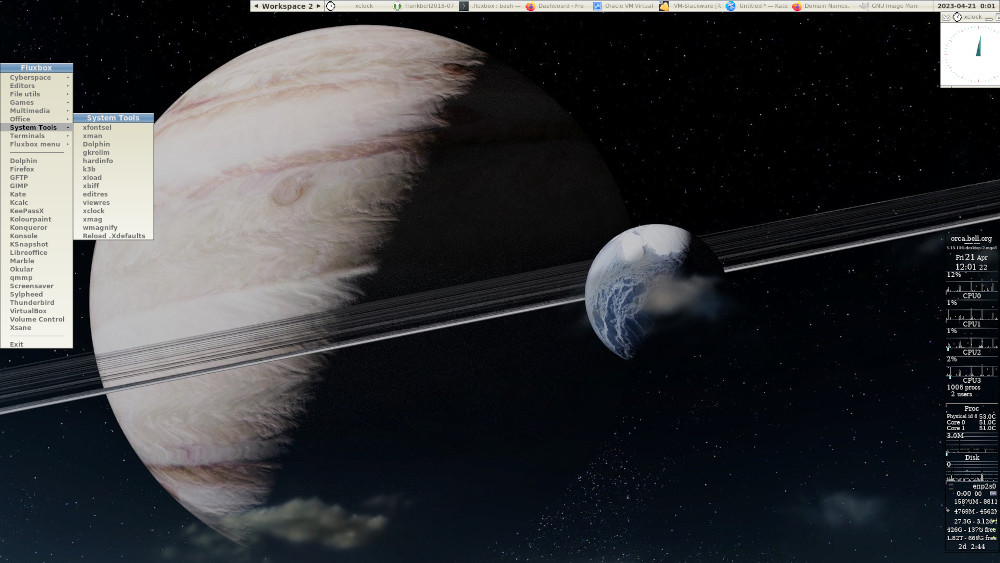
Mageia v. 8 with the Fluxbox window manager. Xclock is in the upper right and GkrellM in the lower right. The wallpaper is from my collection.
The Twitter Fails 0
Rebecca Watson dissects the deception buried in Elon Musk’s and Matt Taibbi’s “Twitter Files.”
. . . or you can read the transcript.
Artificial? Yes. Intelligent? Hardly. 0
At The Roanoke Times, Dan Casey offers a case study in real stupid.
Artificial Covert Intelligence 0
At Psychology Today Blogs Steven Hassan, who has spent four decades studying the use of “undue influence” in cults, politics, and relationships, explores the darker potential of AI. A snippet:
We already know that “social” media isn’t.
In view of the “golly gosh gee whiz” attitude with which many are greeting the AI/ChatGPT hype, I think his piece is worth a look.

Geeking Out 0
Updating a VirtualBox virtual machine (VM) of Manjaro Linux. In the background is another VM of Slackware Linux (the oldest still-maintained Linus distro). The VMs are running on Mageia Linux with the Fluxbox window manager.