








Health and Sanity category archive
We Need Single-Payer 0
Cut through the rhetoric and the lies.
What it means is that the Republican Party does not want you to have affordable health care.
Visit NBCNews.com for breaking news, world news, and news about the economy
Via C&L.

“Best Health Care in the World” 1
More than 2,000 people, many traveling by BART and bus from the East Bay and beyond, waited for hours on end. Some arrived as
Their swollen jaws, painful grimaces and reluctant smiles gave them away.
“I’ve been in line since 5 a.m., and I’m not leaving,” said Carrie Flores, 49, of San Jose, who was hoping a dentist inside the cavernous tent building behind the San Jose McEnery Convention Center would extract two or three of her back teeth and maybe save another. She’s been in so much pain she can’t sleep or eat any solid food.
Also, pigs, wings.
We Need Single Payer 0
PoliticalProf offers a fable about how we establish the cost of health care.
It has a moral, but not morals.
Health (Records) Check 0
My local rag has a long and fairly level-headed article about the security of your computerized health records and related identification information. A nugget, chosen to illustrate the level-headedness:
The number has dropped each year since 2010, said Chris Hourihan, principal research analyst at the Health Information Trust Alliance. However, it’s not yet clear whether that’s because security is improving or because organizations changed their conception of what constituted a significant risk of harm. Starting this year, all breaches are considered potentially harmful and must be reported unless proved otherwise.
Notice the lack of the “OMG we are all going to die!” that is typical of such reports, a lack of the hysteria that keeps Dick Destiny busy over at his place.
Follow the link, check it out.
It includes a list of things you, as opposed to healthcare providers (who must police their own stuff), can do to help protect yourself; most of them are fairly standard stuff that anyone who pays attention to computer security is already doing, such as
- Don’t open attachments from unknown emailers,
- Keep an eye on your credit card statement, bank accounts, and credit reports,
- Be cautious in deciding to enter information in forms at websites, and so on.
The only hint that I would question is the one to use a “virtual private network” (VPN) when connecting to the internet when away from home (for example, at a coffee shop or library with open wireless).
Since most persons likely don’t know what a VPN is, let alone how to set one up on the fly, I would have suggested “Don’t use open wifi for email or confidential business–just don’t–unless you can use a VPN.”
We Need Single Payer 0
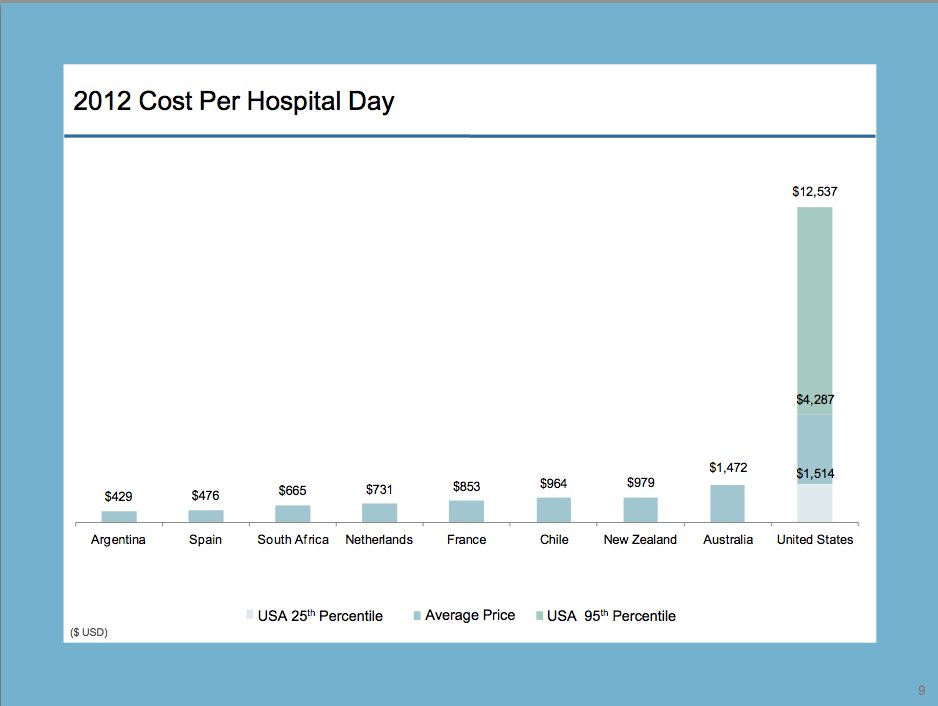
Robyn Blumner reflects on Time Magazine’s recent article on hospital costs (paywall). A nugget:
In nonprofit hospitals where top executives often are paid lavish compensation of $1 million or more, Brill documents how patients are gouged, charged hundreds of dollars for X-rays and other services that Medicare would have reimbursed at little more than $20. In one typical case, a dose of life-saving cancer medicine, already expensive at $4,000, was marked up by the hospital to $13,700 — with no explanation given.
It’s the free market* at work.
Except that, in this case, it’s a seller’s market, so the magickal mystickal competition fairy need not apply.
________________
*AKA, “oligarchy.”
We Need Single-Payer 0
Americablog:
Besides record corporate profits, the insurance companies have been doing quite well also — but this move suggests they want even higher profit margins, since spouses who are not working tend to use health insurance more.
The only thing “insurance” companies want to ensure is executives’ country club memberships.
Spots before Your Eyes 0
In case you wondered why television is littered with ads for products you can’t buy without a doctor’s order, Barnum had the answer: There’s one born every minute.
The practice, which can contribute to higher health care costs, was found to be more likely among doctors who received free drug samples or free food from drug companies or who had financial relationships with drug companies.
Lost in the Land of Oz 0
A doctor began to wonder where his patients were getting their outlandish ideas about supplements and miracle cures.
He dared to look behind the curtain and found himself in a TV wonderland.
Much more at the link.
The Raveling Medicine Show 0
Your for-profit hospitals are at work, demonstating how competition lowers prices.
A nugget from a long story in the Charlotte Observer:
It’s true for services ranging from heart tests to routine office visits. And it’s part of a national shift that experts say is raising costs but not quality.
Hospitals are increasingly buying doctors’ practices, then sending bills for routine services that are significantly higher than those charged by independent doctors.
Just gotta pay for those country club memberships so the hospital administrators can get their exercise.
We need single payer.
Facebook Frolics 0
Susan comments on the Zuckerboard:
So many Facebooks. So little substance.
We Need Single Payer 0
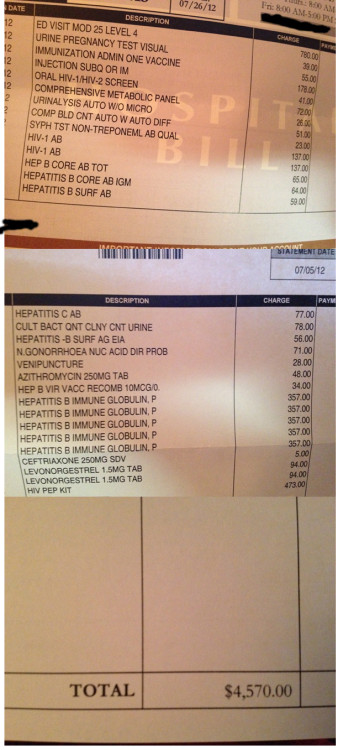
This is twice my salary for my first full-time job:
We Need Single Payer 0
The underspending rebate checks mandated by the ACA are starting to arrive.
Wonder how many insurance company country-club memberships will go begging?
In the Pennsylvania individual market, Aetna Life Insurance Co., which also sells health insurance, spent just 67.1 percent of the money collected from subscribers in 2011 on health care. Averback’s check was a rebate.
Once she realized that the check was real, she had another thought. “I guess that shows you how much they were ripping me off,” she said.
Pizza Panels 2
Papa John’s claims that providing health care for employees might cost as much at fourteen cents a pizza.
That’s too much for Colbert:
There has to be a line we do not cross. And it’s fourteen cents.
If we sit idly by while everyone gets access to doctors for fourteen cents a pizza, tomorrow it may be three cents a taco.
Via TPM.
We Need Single Payer 0
Arizona death panel Republican state legislature at work:
The elected officials who control the state say we can’t afford to expand coverage.
The flaw in that logic is that taxpayers wind up picking up the tab anyway.
Republicanism, your choice for governance with a mean streak by persons with mean streaks on behalf of persons with mean streaks.