







Mammon category archive
Systematizing the Game 0
At the Bangor Daily News, Steven Barken wonders what would happen if Monopoly imitated the American economic system. For example . . .
If Monopoly were more like real life, here’s what would happen.
Let’s assume there are five players, and instead of each player receiving $1,500 at the start, the $7,500 they share to begin the game is instead allocated according to the distribution of wealth among Americans. In this scenario, the wealthiest player, Player A, would begin with about $6,668, because the top fifth of Americans hold about 89 percent of the nation’s wealth. Based on the proportion of wealth held by the next fifth of Americans, Player B would begin with $705. Meanwhile, Player C, representing the middle fifth of Americans, would begin with $195, while Player D would begin with $15. Finally, Player E, representing the bottom fifth of Americans, would begin the game $90 in debt.
Follow the link to see how the game plays out.

The Snaring Economy 0
In an article about Uber imitators is buried this nugget, alsmost as an aside.
Under the guise of “sharing,” the snaring economy is facilitating monopoly (emphasis added).
Follow the link for the rest of the article.
“Nobody Likes You When You Are Down and Out” 0
Sing it, Steve Wynn!
The 74-year-old billionaire then tried to break it down for investors.
“Or to put it in a more colloquial way, rich people only like being around rich people, nobody likes being around poor people — especially poor people,” he said.
Panama Rats, the Moral 1
Daniel Ruth read the Panama Papers and finds a moral:
Yes, countries do saber-rattle. They bluster and fulminate. And occasionally somebody invades somebody else for old times’ sake. But what the Panama Papers prove is the universal glue that holds the world together is greed.
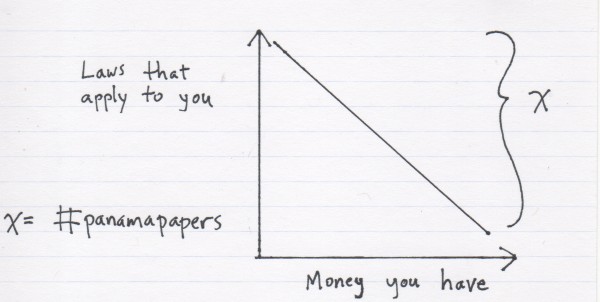
Meanwhile, Above the Law offers this handy graph to help you understand what’s going on here:
How Stuff Works, Panama Rats Dept. 0
Thom talks with Dr. Richard Wolff about what the “Panama Papers” say about the antics of the plutocracy.
Tax Havens 0
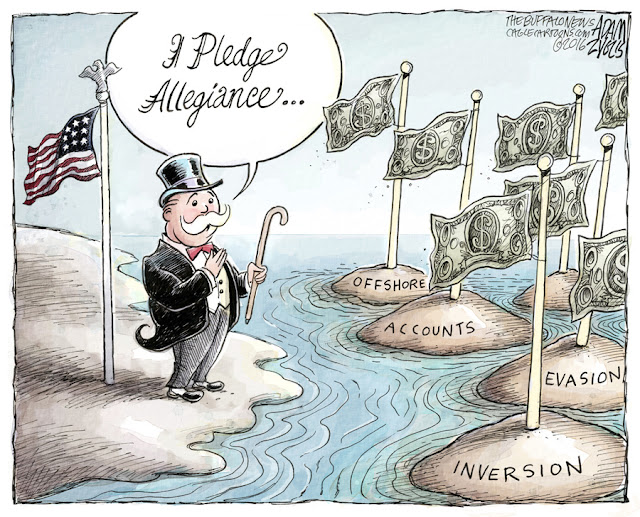
BadTux has a theory as to why so few Americans were named in the Panama Papers.
Here’s the gist; follow the link for the full discussion:
Image via Job’s Anger.
Bad Medicine, Bad Bad Medicine . . . 0
. . . but good news.
The $160bn (£113bn) deal, announced in November, was thrown into doubt following the move by the US Treasury on Monday to make so-called tax inversion deals, by which corporations relocate their headquarters to countries with a lower tax rate, less financially appealing.
Great Moments in You Get What You Pay For (Updated) 1
Facing South points out that among those businesses protesting North Carolina’s “It’s Okay To Hate the Gay” law are a number that helped fund the election of the legislators who sponsored and supported it.
But many of these same businesses funded two outside political groups that helped elect five of the bill’s sponsors, 13 other legislators who voted for it, and McCrory, who immediately signed the measure into law. Outside groups are unaffiliated with campaigns and are not allowed to coordinate with candidates.
At least 36 companies that have come out against HB2 so far have given a combined $10.8 million to those Washington, D.C.-based groups, the Republican State Leadership Committee (RSLC) and the Republican Governors Association (RGA), in recent election cycles.
I have nothing to add, because actions speak louder etc.
Details at the link.
Addendum, Comment Rescue Dept.:
George Smith commented:
Why don’t they just start calling these things Pink Triangle laws?
He has a point.
Model Legislation 0
In the Sacramento Bee, Meredith Hattam discusses proposed California legislation to extent to fashion models (who are, after all, performers) the sane workplace protections that actors have enjoyed for decades. She starts by describing her short career as a fashion model:
I was 5-foot-9, and 135 pounds, an awkward teenager bullied in high school. My mother was in a hospital with a terminal illness, and my father was there with her. Losing weight was probably the only thing I could control. If I had the potential to be a model, why shouldn’t I at least try?
And so I only ate protein and vegetables and ran 3, 6, 10 miles a day. In eight weeks, I had lost 20 pounds, and I returned to the agent’s office. I modeled in California and New York from 2006 until 2010, when I quit to graduate from college. Most of that time, I was starving, though I denied that fact to my father, my friends, my co-workers. My period stopped. I was cold all the time. I stayed up late nights obsessively chronicling how many calories I’d eaten.
Read the rest.
The Rich Are Different from You and Me 1
They have money.
The “Panama Papers” . . . 1
. . . contain no revelation, only confirmation.
If you didn’t already know that the system is crooked, you haven’t been paying attention.
Food for the Ears 0
Harry Shearer interviews David Cay Johnston about Donald Trump and related topics.
Johnston has followed Trump’s careen career for almost four decades. The discussion ranges over Trump’s business dealings, apparent ties with the mob, history of–er–prevarication, and much, much more, with a side trip into business tax law in theory and in practice.
Listen up, y’hear.

How Stuff Works, the Corporate Shell Game Dept. 0
Frank Clemente discusses how multinational corporations dodge their taxes by expatriating themselves. A nugget:
Misdirection Play, Tiny Bubbles Dept. 0
Remember, not every “public interest group” is a public interest group. Witness this “public interest group” that is lobbying against a soda tax in Philly (emphasis added).
I do like my daily diet cola, but, as far as I am concerned, this is like the fellow who, after getting pulled for speeding, turns to the cop and asks, “Why didn’t you pull over that other guy? He was going as fast as I was.”
Flint-Hearted 0
This is contemporary Republican governance writ large, poisoning the poors for profit.