








Political Economy category archive
Why you do not know what you do not know 5
I have often wondered why there is not more public outrage about are high cost of health care, and why people are not demanding change.
If prices were skyrocketing like this any where else you would be hearing about on the evening news every night.
Then it hit me, the largest sponsor of these shows are health care and drug companies. They are not there to sell product as much as to exert editorial control over the news.
Everyone knows it is not wise to bite the hand that feeds you, so it stands to reason stories that you should be seeing, like 150% longer ER waits for heart attacks and 300% ER longer waits for everything else go unreported.
You call it financial censorship or lies by omission, but it is causing a lot of pain and suffering.

Bushonomics 1
With his household debt soaring from a $123,000 mortgage in 1990 to a $425,000 mortgage on the same house by 2006, Frank and his wife, Joan, are a striking example of how the housing bubble’s easy credit allowed consumers to bury themselves in debt.
Now, they are struggling to avoid the worst consequence of what Frank called “crappy decisions.” That would be the loss of their house in Bucks County’s Warwick Township. “I’m not an Oprah victim. I don’t blame anybody,” he said.
No mention, of course, of the failure to regulate the financial industry to keep the industry from selling bags of air.
Stagdeflation huh!!! 0
A brand new worry bead for our worry bead chain has arrived (like we needed it) Stagdeflation!
Normally I would discount it, but it comes from Nouriel Roubini, the guy who seems to get everything right, with a second from George Soros, no dummy himself. They calculate that we are headed into a total financial meltdown so severe that inflation will turn into deflation. This is 1930’s stuff. And coming from Roubini, you can not brush it off.
They unveiled this term at the Davos conference in Switzerland, so it was not meant for our ears, but thanks to the Internet there are no secrets anymore. To be clear, deflation does not normally happen in a recession; it takes a world wide depression to make prices of everything to fall. Both Roubini and Soros gave it a high probability. so be careful out there!
Now I have no ideas about where to put your money.
THE great depression redux 8
I was watching CNBC all day as usual today, and as has been the case all year, all the news was bad. Retail sales bad, even at Walmart; first time jobless claims way too high; housing starts way to low. All this endless bad news is pointing to a consumer led recession that is going to be a long lasting bear of a problem. The most troublesome thing about it includes inflation pressures on the consumer in areas such as food, energy, and health care that could well escalate instead of moderate. Add to that we have stagnent wages , no savings, declining home values, and record credit card debt.
The tune “Brother Can You Spare a Dime” keeps playing in my head.
we have created a hell of conundrum for ourselves 14
Conundrum defines an intricate and difficult problem. This is in regard to use of ethynol as a automobile fuel. The price of a bushel of corn doubled last year, from 2 to 4 dollars a bushel, causing food prices to rise to record levels. This sets up a painful problem: even if oil prices fall it will cause us to use more ethynol because we will drive more. Since our gas is mixed with corn oil, food prices will rise even higher causing, real hardship for families especially. Talk about being stuck between a rock and a hard place. We finally get lucky, but we don’t save a dime.
It Is To Laugh 0
While listening to the morning news on a station that I will not humiliate by naming it, I actually heard a reporter refer to Republicans as “fiscal conservatives.”
Yeah.
The Downside of the Fed Interest Cut 1
Theeeyyyyy’rrrreeee back . . .
The automated spam phone calls trying to sell me loans I don’t need from outfits I never heard of.
Six calls made it through the Caller ID check and the outgoing answering machine message and onto the answering machine in the past two days.
Lord knows how many of the other dozen or so calls that failed the Caller ID check in that time were more of the same.
Dammit, I’m old fashioned (in addition to being old)
If I need a loan, I’ll do it the traditional way.
I’ll just overextent my credit card.
I certainly wouldn’t take a loan from some unknown bozo who calls me up on the tellyphone.
I’ll get it from a known bozo.
Tax Fraud 0
AKA Reaganomics voodoo economics.
The Big Lie of Republican economic policy.
From Fact Check dot org. Follow the link for a more nuanced explanation, including very a description of the very limited circumstances in which there may be a soucon of truth hidden in the Big Lie:
A: No. In fact, economists say tax cuts do not spark enough growth to pay for themselves.
But it is without doubt that Republican tax cuts make the rich richer and the poor poorer.
That’s why Republicans have to lie about them.
Bushonomics 0
If this isn’t a recession, it’s looking an awful lot like one.
The unemployment rate has taken the biggest jump since the 2001 terrorist attacks, a key gauge of manufacturing activity has fallen to a five-year low, and now consumer spending, which had been a standout performer, is starting to sag.
The Commerce Department reported yesterday that retail sales fell a sharp 0.4 percent in December, handing retailers their worst Christmas in five years.
It seems that consumers, who account for two-thirds of total economic activity, have slowed their spending in the face of an array of problems. And the worry is that they may cut back further.
Already, consumer confidence has slipped significantly amid the spiral of oil prices, the sagging of home prices, the rising of mortgage defaults, and the increasing of unemployment.
Of course, this is what happens when the ruling party believes the wealth is an indiator of virtue and that selling the country to the highest bidder is wise public policy.
Bushonomics (Updated) 0
BBC:
It said that Friday’s employment report, which sent shares tumbling worldwide, confirmed that the US is in the first month of a recession.
Its view is controversial, with banks such as Lehman Brothers disagreeing.
But a reserve member of the committee that sets US rates warned that it could do little about the below-trend growth expected in the next six months.
“I am concerned that developments on the inflation front will make the Fed’s policy decisions more difficult in 2008,” Charles Plosser, president of the Federal Reserve Bank of Philadelphia said.
Via Raw Story.
Addendum, the Next Morning:
An opposing view, using a somewhat unorthodox economic indicator:
Robert McLellan has his own leading economic indicator, and it’s not pointing toward a recession.
McLellan, the chief operating officer of Accurate Lift Truck Inc., of West Berlin, said he watched the company’s fleet of forklifts available for short-term rentals.
If Accurate’s customers – warehouses, trucking companies and others – are busy moving goods, the economy is perking right along and his short-term rental fleet of forklifts “is flying out the door,” McLellan said.
And how is business now? “We’re probably 95 percent rented,” he said. That is actually more than he would like.
“The rule of thumb is, you should never be more than 85 percent rented,” to ensure smooth operations, he said.
Get Those Homeless Shelters Ready (Updated) 1
It’s just gonna get worse.
That’s bad news for house prices.
“Foreclosures are adding to the inventory of unsold homes, and are worsening the housing outlook,” said Patrick Newport, an economist with Global Insight Inc., an economic research firm in Waltham, Mass.
Foreclosures are concentrated in California, Arizona, Nevada, Arizona, Florida, Michigan and Ohio. Those states are going to face the most severe downturn in house prices – 20 percent to 30 percent in some areas.
And get ready for the solution from the Current Federal Administration: More tax cuts for the rich (via Susie):
When the economy is doing reasonably well, the debate is dominated by hype — by the claim that America’s prosperity is truly wondrous, and that conservative economic policies deserve all the credit.
But when things turn down, there is a seamless transition from “It’s morning in America! Hurray for tax cuts!†to “The economy is slumping! Raising taxes would be a disaster!â€
Addendum, 1/8/2008:
Those would be the tax cuts, heavily skewed to the rich, that don’t even expire for three more years.
But wait!
Making the Rich Richer 0
How it was done:
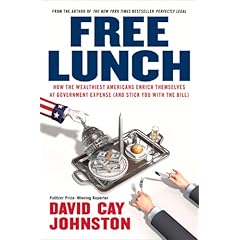
The author was interviewed on Fresh Air last week. From the website:
Cay Johnston covers tax policy for The New York Times, where he won a Pulitzer Prize for his reporting on that beat. His previous book, Perfectly Legal: The Covert Campaign to Rig Our Tax System to Benefit the Super Rich — and Cheat Everybody Else, was a best seller.
His description of how the Current Federal Administrator got his fortune by spinning the Texas Rangers for taxpayers’ money and a tax increase is well worth the 45 minutes of the interview. (If you want to go right to it, it’s approximately–and I do mean approximately, as I was in the dental chair when I listened to it–it’s about 20 minutes in.)
Follow the link to the website; it’s well worth a listen.
Bushonomics 3
Executive vice presidents could claim retention awards of $1 million each, and senior vice presidents could get $600,000, provided they stay with the company until 2011, according to a filing late Wednesday with the U.S. Securities and Exchange Commission.
“The purpose of the award is to ensure the stability of the company’s leadership team,” the company said.
In March, the company said it would lay off 3,400 store workers and replace them with lower-paid new hires to try to fend off larger competitors.
Meanwhile, back on the bread line:
“I usually come early and it’s not like this,” said Willie Smith, a 47-year-old regular client at the pantry.
By 11 a.m., the official closing time, there were still 12 people awaiting food. No one got turned away, but food-bank clients were surprised by just how many hungry people there are these days.
“We are struggling right now,” said Joanne Lelli, 39, a laid-off Wal-Mart worker and single mother of a 10-year-old girl with cystic fibrosis. She says she often has to choose between food and heating oil.
The country is filled with people making just that choice. And food banks are feeling pressure to get people through.
The Republican Party, now and always the Party of Privilege.
Pop! 0
Well over a year ago, I discussed the possibility that there was a housing bubble.
Today’s local rag had a story about a business analyst who got it right:
Finally, in e-mails and meetings with her firm’s money managers, Troll urged T. Rowe Price to sell its portfolio of subprime-mortgage securities.
“I just was amazed at how quickly these deals were getting done when you see constant deterioration in credit quality,” she said. “It just didn’t make sense.”
Based on her warnings, the Baltimore investment firm sold some of its subprime assets in December 2006 and cleared its books of them by early February – well before the summer’s credit crisis erased the market for these types of securities.
Ya know, this stuff ain’t rocket science. That doesn’t mean it can be done as a sideline either–it takes time to do the homework.
But what it boils down to is verifying that the investments reflect real value, rather than hopes and wishful thinking.
It’s like the sign on the Antique Shop: “We buy junk. We sell antiques.”
Unfortunately, changing the label does not change the product.
McMansions. McDoughnuts (Updated) 0
Investors met in Philadelphia.
The subprime crisis, which has claimed the jobs of three chief executive officers and prompted more than $45 billion in write-downs at the world’s biggest banks, may end up spilling into 2009.
“These events tend to become deeper and play out longer than most people initially expect,” said Michael Mayo, an analyst who covers securities firms at Deutsche Bank AG in New York. “This is one of the slowest-moving train wrecks we’ve seen.”
The tumbling U.S. housing market will continue to inflict the damage. Mortgage-backed securities and collateralized debt obligations containing those securities are falling in price and will not find their footing anytime soon. That’s because most of the subprime mortgages, which provide collateral for $800 billion in securities, have yet to go bad, said Christopher Whalen of Hawthorne, Calif.-based Institutional Risk Analytics.
And the U. S. housing bubble is bursting all over the world.
Note the banks cited in the article:
American securities firms sold their “securitized” junk all over the world.
In The Wealth of Nations, Adam Smith talked about the “invisible hand” of supply and demand. Sadly for the mortgage hucksters, the “invisible hand” works reliably only when the producers are producing real stuff, stuff that people need and use, not when they are producing phony stuff, financial vaporware.
And who is producing real stuff these days?
China. Korea. Japan. Malaysia. India.
And who is producing financial vaporware?
American financial houses.
Our economy has become a house of cards, dealt by card sharks.
Addendum, Later That Same Evening:
Follow the link.
A View on Immigration 4
This is the first explanation of the “why” for the wave of illegal immigration that I have seen. The author has a hypothesis as to why illegal immigration has exploded in the past two decades.
What do y’all think?
On Immigration and Population Demographics Raymond Krauss Lost in the current debate on immigration reform is the decline of fertility rates in the latter part of the 20th century in the United Stated. The fertility rate during the post WW II baby boom (1946-1965) averaged 3.5. After 1965, the rate dropped below 2.0 and stayed there. This baby boom bulge is about to cause the graying of America and with it serious problems for our economy, social security and Medicare.
The high fertility rate of the baby boomers (more children were born between 1948 and 1953 than the previous 30 years combined) would have spelled disaster in most other parts of the world. But here and in Europe, it caused an economic boom the likes of which the world had never seen. American business rode high on a mighty demographic wave. Sales in everything from hula hoops to personal computers rose thanks to a steadily growing customer base. As this baby boom wave recedes into retirement, sales will fall, and the economy will need to contract, rather than expand. The 60 year economic boom we have enjoyed may well turn into a bust. Real estate will be hard hit. Fewer young and middle aged people mean lower demand for housing and lower prices. This has already started. A slower economy also means lower tax revenues for the government.
This brings us to the social security crisis. The baby boomers will live longer and collect benefits longer than ever before, and lower rates of fertility are restraining the growth of the working age population who pay social security taxes. Under the current system, this will mean severe increases in social security withholding taxes for the same working age population.
Depopulation will cause even more problems with the working man’s Medicare deductions. Medicare problems are two fold: the rising number of enrollees and the rapidly climbing costs of medical treatment. The expansion of the elder population would not in itself be a problem if the number of workers paying into the program were growing at an equally rapid pace. Unfortunately, the labor force will be growing much more slowly than the retiree population for decades after 2010. It all comes back to the baby boom phenomenon. Again, the net result, less take home pay for working age people.
Relevance 0
Dan Froomkin:
Asked how he found himself vetoing a children’s health insurance bill that had passed Congress with bipartisan support, Bush insisted that using a veto is “one way to ensure I am relevant.”
When a reporter followed up and asked Bush if he felt he was losing leverage and relevance, Bush replied: “I’ve never felt more engaged and more capable of getting the American people to realize there’s a lot of unfinished business.”
Which, let’s be blunt, is hard to believe.
(snip)
“There is a real question among Americans now about how relevant this government is to them,” pollster John Zogby told Whitesides. “They tell us they want action on health care, education, the war and immigration, but they don’t believe they are going to get it.”
Another take on relevance. Adrianna Huffington:
Yeah, the Current Federal Adminstrator is relevant.
So is a boil.
It causes pain until
. . . it
. . . goes
. . . away.
Exit, Stage Right 0
The Washington Post recently explored the exit of top aides from the Current Federal Administration:
All the more so in a White House beset by an intractable war, a hostile Congress, a shipwrecked domestic agenda and near-historic-low approval ratings. The long-term ideals that many of them came to the White House to pursue appear jeopardized, even discredited to many. They tell themselves that they have acted on principle, that the decisions they helped make will be vindicated. But they cannot be sure.
A number of the persons quoted in the article expressed regrets of various kinds.
But nowhere did they express regret for betraying the ideals of the founders and dragging the sacred honor of this nation in the dirt.
Sub-Prime 0
Robert Reich on bailouts. Read the whole thing. It’s worth three minutes of your time:
The real moral hazard in this saga started when Fed Chair Ben Bernanke cut the Fed’s discount rate (charged on direct federal loans to banks) and announced that the Fed would take whatever action was needed to “promote the orderly financing of markets.” Translated, this means that lenders, credit-rating agencies, financial intermediaries, and hedge funds will be bailed out, one way or another, because they’re simply too big to fail. Note that behind every one of these institutions lie thousands of well-paid executives who would have lost big if the Fed didn’t come to their rescue. Even though they had more information and experience at risk-taking than the suckers who borrowed their money, and even though executives at the top of these instutions typically earn more in a day than the borrowers do in a year, moral hazard somehow doesn’t apply to them.