








Political Economy category archive
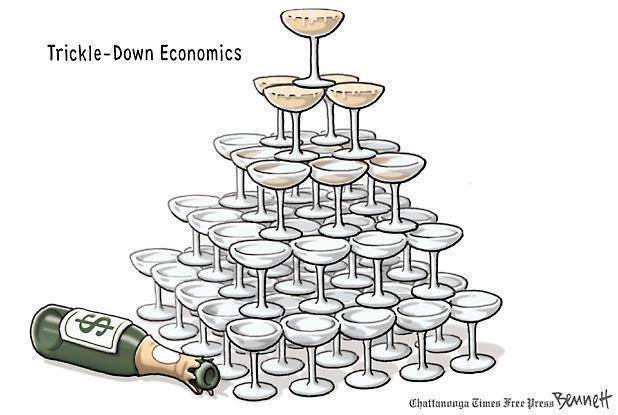
Responsible Fiscals 0
Warning: Language.

The Price of Civilization 0
In the Minneapolis Star-Tribune, Eliot Seide reflects on preparing his tax returns. A snippet:
My tax day anxiety was swept away by thoughts of things I’m truly grateful for.
I started my day with a warm shower. That reminded me how thankful I am for clean water and indoor plumbing. For much of the world, that’s a luxury. But not here, where we pay taxes.
I enjoy driving on smooth highways. The lines and lights keep me and other drivers safe. I sometimes like to leave the car in the garage and ride the train to a ballgame. I love the sense of community that comes with riding public transit.
Public services and the common good aren’t free, my friends, though some would like to con you into thinking that they are.
Theft of Labor 0
Thom discusses Donald Trump’s recent executive order nullifying President Obama’s workplace safety initiative and how it facilitates theft of labor.
The Snaring Economy 0
Josh Marshall points out that there is nothing new about the “gig” economy. It has happened before, and it wasn’t pretty then, either.
Billions for Bullets 0
At the Boston Review, takes a look at arguments for increasing defense spending not just wanting, but spectacularly specious. He makes some points that are commonly absent from the discussion and deserve consideration. Here’s a snippet:
A larger flaw in McCain’s argument, however, is that, by historical standards, not much is actually burning. And, more importantly, the United States does not need to go looking for fires to extinguish. The world remains far more peaceful by various measures than at almost any other point, and the United States still enjoys a privileged position: militarily powerful and distant from trouble. U.S. enemies are historically few and weak; U.S. defense spending is more than double what Russia, China, Iran, and North Korea collectively spend on their militaries; and U.S. forces remain vastly superior. North Korea and Iran are troublesome, but incapable of posing much direct threat to their neighbors, let alone the United States, especially considering nuclear deterrence. Russia threatens its neighbors, but with an oil-dependent economy now about the size of Italy’s, it poses little danger to more economically stable nations further west.
Be Careful What You Wish for 0
Thom tangles with a glibertarian.
Nothing To Do, Nowhere To Go 0
Still well under 300k.
(snip)
The four-week average of claims, a less-volatile measure than the weekly figure, declined to 245,500, the lowest since 1973, from 247,500 in the prior week.
The number of people continuing to receive jobless benefits increased by 41,000 to 2.1 million in the week ended Jan. 14. The unemployment rate among people eligible for benefits held at 1.5 percent. These data are reported with a one-week lag.
Nothing To Do, Nowhere To Go 0
Enjoy it while it lasts.
Key Points
- Jobless claims declined by 15,000 to 234,000 (forecast was 252,000) in the week ended Jan. 14
- Previous week’s claims revised to 249,000 from 247,000
- Continuing claims dropped by 47,000 to 2.05 million in the week ended Jan. 7
- Unemployment rate among people eligible for benefits, also reported with a one-week lag, was unchanged at 1.5 percent
Nothing To Do, Nowhere To Go 0
Still under 300K.
(snip)
The four-week moving average decreased to 256,500 last week, from 258,250. . . . .
The number of people continuing to receive jobless benefits dropped by 29,000 to 2.09 million in the week ended Dec. 31.
Nothing To Do, Nowhere To Go 0
Still well under 300k.
(snip)
The four-week average of claims, a less-volatile measure than the weekly figure, decreased to 256,750 from 262,500 in the prior week.
Nothing To Do, Nowhere To Go 0
Still nicely under 300k.
(snip)
The four-week average of claims, a less-volatile measure than the weekly figure, fell to 263,000 from 263,750 the prior week.
The number of people continuing to receive jobless benefits climbed by 63,000 to 2.1 million in the week ended Dec. 17, the highest since Sept. 10.
Nothing To Do, Nowhere To Go 0
Still under 300k, but up a bit.
(snip)
The four-week moving average increased to 263,750 last week, from 257,750.
The number of people continuing to receive jobless benefits rose by 15,000 to 2.04 million in the week ended Dec. 10. The unemployment rate among people eligible for benefits held at 1.5 percent. These data are reported with a one-week lag.
Nothing To Do, Nowhere To Go 0
Still under 300k.
Claims have stayed below the 300,000 level for 93 consecutive weeks, the longest stretch since 1970 and typically consistent with an improving job market.
(snip)
The number of people continuing to receive jobless benefits rose by 11,000 to 2.02 million in the week ended Dec. 3. The unemployment rate among people eligible for benefits held at 1.5 percent. These data are reported with a one-week lag.
Enjoy it while it lasts, folks.
Jobs Con Job 1
Alan Caron points out an uncomfortable truth. A snippet:
But the notion that campaign promises can revive the 20th century economy belongs on the pages of the National Enquirer at the supermarket checkout stand. It’s nonsense.
For every one manufacturing job we’ve lost to trade deals and government actions, we’ve lost seven to eight to machines, computers and robots. Governments don’t control technological progress, new inventions, time-saving devices and brilliant breakthroughs. Heck, government is usually the last place to employ those things. And technological progress is what’s costing us jobs. The sooner we understand that, the better off we’ll be.
What’s missing from the “jobs” equation is this: The wealth created by this “progress” is not being shared; it’s being hogged.
And, as George Orwell told us, some pigs are more equal than others.
All That Was Old Is New Again 0
Thom and Richard Eskow discusses similarities between Donald Trump’s cabinet of deplorables and Republican cabinets of the 1920s.
Jen Sorenson has more. Here’s a snippet (emphasis added):
Trump’s version of a political and financial establishment, just forming, will be bound together by certain behavioral patterns born of relationships among those of similar status, background, social position, legacy connections, and an assumed allegiance to a dogma of self-aggrandizement that overshadows everything else. In the realm of politico-financial power and in Trump’s experience and ideology, the one with the most toys always wins. So it’s hardly a surprise that his money- and power-centric cabinet won’t be focused on public service or patriotism or civic duty, but on the consolidation of corporate and private gain at the expense of the citizenry.
Welcome to the kelptocracy.
That Pesky Dialectic of Materialism, It Just Won’t Go Away 0
At the Boston Review, Alex De Waal remembers Karl Polanyi’s The Great Transformation, which was written in 1944 and analyzed the events leading from the Napoleonic Wars to the World Wars from a social and economic perspective. De Waal applies that same analysis to the events since 1945. His conclusions do not give reason for optimism.
The article is long and densely reasoned and so depressing that it’s taken me three days to wade through it. I urge you to read the whole thing, even if it takes you three days . . . .
Here’s just a bit to either whet your appetite or scare you away (emphasis added).
(snip)
So now—a winning minority of the electorate having lodged its protest and voted for its own gravedigger—the logic of today’s political economy is laid bare. What then can we take from The Great Transformation to deepen our understanding of our predicament? Polanyi’s central conclusion is that unregulated capitalism promised a “stark Utopia” of great wealth but destroyed the social and material basis of a humane society. Just over a hundred years ago, nineteenth-century Western liberal civilization reached its apogee, which was also the moment at which it could no longer contain the forces of disorder that it had unleashed. The massive destruction of the world wars, the communist revolution, fascist imperialism, and the Great Depression followed. Capitalism was reprieved by the political dispensation that followed World War II. John Maynard Keynes provided the intellectual capital for managing the market, and the victors of the war recognized that full employment, social welfare, and a good measure of equality were necessary to save civilization. But capitalism’s dangerous tendencies remained and, once freed from the challenge of socialism, its utopian dogma was again ascendant. The inevitable crisis is now here.