








Political Economy category archive
Nothing To Do, Nowhere To Go 0
No change for all practical purposes:
(snip)
The number of people continuing to receive jobless benefits dropped by 64,000 to 2.46 million in the week ended Aug. 23, the fewest since June 2007. The unemployment rate among people eligible for benefits held at 1.9 percent during that period, today’s report showed.

Who Do That Voodoo Economics 0
Leonard Pitts, Jr., considers whether Republican economic theory is a spell or a curse. A nugget:
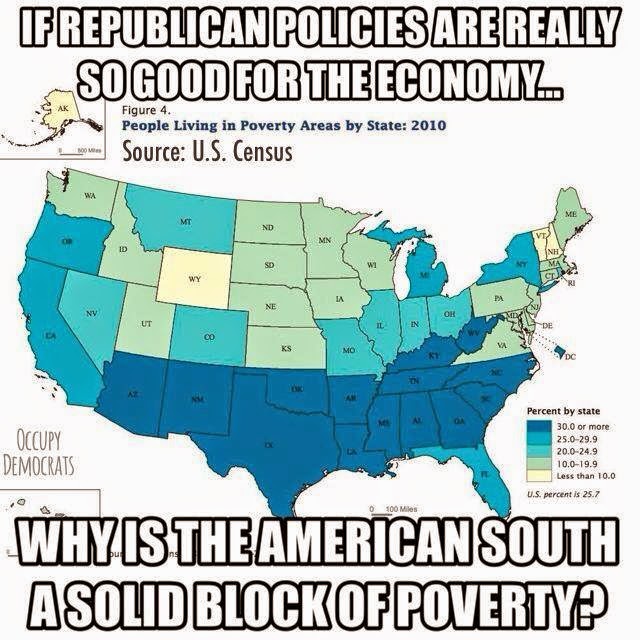
Yet, every election season the party nevertheless makes those claims. It will surely do so again this fall. So it seems fair to ask: Where are the numbers that support the assertion? Why is Texas only middling in terms of per capita income? Why is Mississippi not a roaring engine of economic growth? How are liberal Connecticut and Massachusetts doing so well?
Read the rest.
Nothing To Do, Nowhere To Go 0
Status quo ante.
(snip)
The four-week average of claims, a less-volatile measure than the weekly figure, declined to 299,750 from 301,000 the week before.
The number of people continuing to receive jobless benefits climbed by 25,000 to 2.53 million in the week ended Aug. 16.
(Anti-)Drug Cartels 0
Frank Carabino has a few thoughts about drug cartels.
Not, not those drug cartels–the other drug cartels, the ones that profit from warring on drugs. A snippet (much more at the link):
Expanding public access to legal marijuana is bad for business.
Locking people up for minor drug offenses and maintaining a monopoly on the bountiful pain-relief industry are two aspects of the status quo that law enforcement and physician groups have an interest in maintaining.
His point regarding law enforcement is obvious. Warring on drugs has been been a prime source of funding and power for police agencies; it’s also brought them lots of cool toys (as we have recently seen displayed in Ferguson) and property. In addition, it enables them to feed the prison industrial complex with thousands of new captives every year.
We are not normally so willing to view the actions of medical associations so cynically, but do not confuse your kindly family practitioner with his or her professional association. Remember that the AMA coined the term “socialized medicine” over half a century ago in its campaign against President Truman’s effort to improve Americans’ access to health care for fear it might cut into its members’ wealth. You don’t get much more cartel-ly than that.
Nothing To Do, Nowhere To Go 0
Back under 300K.
(snip)
The monthly average of claims, a less volatile measure than the weekly figures, rose to 300,750 last week from 296,000.
The number of people on jobless benefit rolls declined by 49,000 to 2.5 million in the week ended Aug. 9. It’s at the lowest level since June 2007, before the last recession began.
In other news, Bloomberg’s “experts” were wrong again.
Nothing To Do, Nowhere To Go 0
Back over 300K.
(snip)
The four-week average of claims, a less-volatile measure than the weekly figure, increased to 295,750 from 293,750 in the prior week that was the lowest since 2006. Last week’s average is still well below the 318,700 mean so far this year.
Bloomberg’s “experts” were, predictably, wrong again. I don’t know why they even bother . . . .
Voodoo Economics . . . 0
. . . casts an evil spell in Kansas.

Nothing To Do, Nowhere To Go 0
Better–back under 300K.
(snip)
The four-week average, a less-volatile measure than the weekly figure, dropped to 293,500, the lowest since February 2006, from 297,500 the week before.
In one reassuring development, Bloomberg’s “experts” are back into their rhythm. The predicted an increase.
Nothing To Do, Nowhere To Go 0
Looking up a bit. (The most surprising part of this is in bold.)
The four-week average of jobless claims, considered a less volatile measure than the weekly figure, dropped to 297,250, the lowest since April 2006, from 300,750 the prior week. Claims in the period ended July 26 climbed to 302,000, in line with the median forecast of economists surveyed by Bloomberg, from a revised 279,000 the prior week that was the lowest since 2000.
Nothing To Do, Nowhere To Go 0
Under 300k.
(snip)
The four-week average of jobless claims, considered a less volatile measure than the weekly figure, decreased to 302,000, the lowest since May 2007, from 309,250 in the prior week.
The number of people continuing to receive jobless benefits declined by 8,000 to 2.5 million in the week ended July 12, the fewest since June 2007. The unemployment rate among people eligible for benefits held at 1.9 percent, today’s report showed. These data are reported with a one-week lag.
None of Bloomberg’s “experts” were even close. I don’t know why they even bother.

The Parked Economy 0
My local rag has an odd story about research by a local professor which seems to point to a correlation between whether persons “front-in” or “back-in” parking spaces and their economic behavior. A snippet:
He then looked at recent economic statistics, such as savings rate and growth in gross domestic product, and found that the more reverse parkers, the more economic success.
For example, of the six countries, China enjoyed the largest annual productivity increase from 2001 to 2011 – 17.8 percent. Virtually tied on the bottom were Brazil (1.3 percent) and the United States (1.5 percent). “Based on the way people park,” Li wrote, “we can gauge their economic performance.”
The link, Li said in an interview last week, is whether a society leans toward instant or delayed gratification. Rear-first parkers, he reasoned, are delayed-gratification types: They take more time to park so they can have a quicker getaway.
Note that he is not claiming causality, merely correlation.
Full Disclosure:
I usually back into parking spaces, but gratification of any sort has little to do with. It’s simple visibility.
If I get caught parked between two honking great SUVs, I’d much rather front out than back out.
Casino Dreams 0
The Atlantic City casino dream is crashing and, as it crashes, it beggars honest workers.
Casino gambling is a mug’s game. It has always been a mugs’ game, just as the lottery in a mug’s game. The house always wins; the marks always lose. Those who would base their fortune on casino gambling are mugs and losers.
Financing public services by playing a mugs’ game because politicians fear to assess taxes–the price of living in a civilized society, by the way–is a con and a fraud, a mug’s gambit. Like all cons and frauds, it ultimately fails (think Bernie Madoff and Enron). In AC, the con and the fraud is failing big time.
Only the con artists and the fraudsters, who cash in early and get out quickly, benefit, as they play their (you will pardon the expression) Trump cards while leaving the citizenry holding the bag.
Depending on “gambling revenue” to pay for public services is an attempt to take the easy way out of governance.
There is no easy way out of responsibility. The citizenry forgets that at its peril
Nothing To Do, Nowhere To Go 0
For all practical purposes, no change: Still above 300k.
(snip)
The number of people continuing to receive jobless benefits dropped by 79,000 to 2.51 million in the week ended July 5, the fewest since June 2007. The unemployment rate among people eligible for benefits fell to 1.9 percent from 2 percent, today’s report showed.
Bloomberg is all a-twitter with optimism because it was lower than their experts predicted, forgetting that that is ultimately a meaningless observation.
Misdirection Play, Fee Hand of the Market Dept. 0
The Gloomy Historian explains how the concept of the “free market” has become a misdirection play. A nugget:
When abstractions are spoken of as real things, we call it reification. Reification is a semantic fallacy, but its use is sometimes necessary when one wants to communicate complex realities with considerably less words. However, a semantic fallacy, if not challenged, can go on to support faulty conceptualizations of reality, especially once it seeps into discourse. The special problem in this case is that the reification complements an ideology, one that rejects the natural and necessary role of the government in the maintenance of the economy