








Political Economy category archive
Update from the Foreclosure-Based Economy 0
Foreclosures continue to work their magic.
(snip)
A key reason for the dismal 2011 sales is that builders must compete with foreclosures and short sales—when lenders accept less for a house than what is owed on the mortgage.

Nothing To Do, Nowhere To Go 0
Still holding under 400k.
(snip)
The four-week moving average, a less volatile measure than the weekly figures, fell to 377,500 last week from 380,000.
Food Stamps by the Numbers 2
Facing South takes on the Newtonian lies with facts.* Here’s a few; follow the link for the rest (emphasis in the original):
Number of people who became SNAP beneficiaries under President George W. Bush: 14,700,000
Number of people added to the SNAP rolls in the 12 months before Obama took office in January 2009: 4,400,000
Percentage by which that exceeds the number added in 2007, when the economic downturn began: 300
________________
*Fact: noun. Concept irrelevant to Republican campaigns.

Down Perryscope 0
Daniel Ruth pens a brilliant, acerbic obituary for Rick Perry’s candidacy.
Here’s a bit.
Perry didn’t run a presidential campaign. He ran as the poster child for civics illiteracy in America, and by the time he quit the race Thursday he had made the George W. Bush years look like the Age of Enlightenment. This was too much even for the voters of South Carolina.
Read the whole thing, not just for the bits about Perry, but for what it says about the clown car that the nominating process has become.
The Fee Shiv of the Market 0
How regulations are killing the Mafia:
The Resilience of the Faithful, Conventional Wisdom Dept. 0
The touching faith in developer magic–the childlike belief that someone in a business suit waving a PowerPoint presentation will miraculously transform a city–never dies.
Witness this, which the resident curmudgeon at my local rag demolishes most convincingly.
I think the belief in developer magic is the belief of the desperate. The city fathers can’t make the Ford plant reopen; new plants don’t seem to get built except in far away places with strange sounding names.
Heck, they can’t even keep track of who’s on the payroll.
So they turn to burning money to developer gods to attract the conventions that will never come.
Once again, persons go to hotels to visit cities. They don’t go to cities to visit hotels.
Conventions go to Chicago, Las Vegas, San Franscisco, and other cities because the conventioneers want to go to cities like Chicago, Las Vegas, and San Francisco. Their convention centers have succeeded because persons want to visit the cities; the cities haven’t succeeded because persons want to visit the convention centers.
Virginia Beach is a nice town with a nice beach; visitors come for the beach, not for the hotels.
Norfolk is a nice little city (unlike Virginia Beach, Norfolk feels like a city) with a Naval base or two or three; visitors come to see their friends and family off to deployment.
As great a museum as the Chrysler is, the Smithsonian it’s not; as nice an urban neighborhood as is Norfolk’sHistoricGhent (I swear, the way it’s described by all the radio announcers it is one word), it is no Greenwich Village–it’s not even Fort Washington.
Nevertheless, desperate persons do desperate things, so I expect that City Fathers throughout the nation will continue to worship at PowerPoint rites and to burn money on the altar of developer magic, hoping to conjure up a replacement for that defunct industry or missing plant now decamped abroad.
Afterthought:
If developer magic is such a sure thing, why are the developers not able to cast their spells over private investors?
![[Two smiling people at a table. One is saying “I’m so happy we live in a world without slavery and imperialism.” There are boxes pointing to various objects around and on the people. They read:
COTTON: Picked in Uzbekistan where 2 million children as young as 7 are forced to pick cotton for 3p a kilo.
APPLES: Picked in California by Mexican migrant workers, not being paid minimum wage nor provided housing.
LAPTOP: Made in China by adults working 18 hours a day at 32p an hour. The laptop will end up back in China’s landfills, where children will dismantle it for its valuable metals including lead.
MOBILE PHONE: Gold, tantalum, tin, and tungsten mined in Congo in abysmal working conditions, causing disease and the regional conflict responsible for the deaths of over 5 million people and systematic rape of women.
ORANGE JUICE: Picked in Chile by women working 60 hours a week, below minimum wage.
FACE: Detoxed with Dead Sea salts sourced in occupied West Bank; land stolen by Israel from Palestinians, who are subject to continual and severe human rights violations.
COFFEE: Picked in Guatemala where entire families with children as young as 6 are forced to pick a 100-pound quota in order to get the minimum wage of less than £2/day
SHIRT: Sewn in India under forced labour conditions by people earning less than 25p an hour, for 16 hours a day, while being unable to send their children to school.
DIAMOND: Mined in Sierra Leone by children as young as 7, working in dangerous conditions for 10p an hour, six days a week.]](http://25.media.tumblr.com/tumblr_lxp6bd9syN1qfu6vwo1_500.jpg)
Crawling with Cats 0
This is sad.
“Before the foreclosure crisis, we had 200, 250 in care,” Pierantozzi said. “Now we’re close to 400. … It’s not just a Delaware problem. It’s nationwide.”
When I was moving two years ago, Faithful Friends helped me find a home for one of my dogs. They do good.
Nothing To Do, Nowhere To Go 0
A turnaround. Of sorts.
The experts who could not predict this reckon it was the temporary Christmas help being let go.
Nothing To Do, Nowhere To Go 0
Looking slightly better.
(snip)
The less-volatile four-week moving average (INJCJC4) decreased to 373,250, the lowest since June 2008, from 376,500.
The number of people continuing (INJCSP) to collect jobless benefits fell by 22,000 in the week ended Dec. 24 to 3.6 million. The continuing claims figure does not include the number of workers receiving extended benefits under federal programs.
The Entitlement Society 0
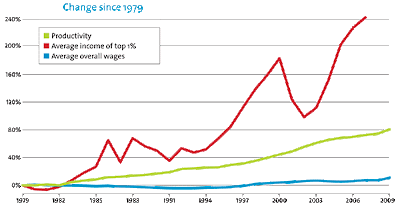
At SFGate dot com, the San Francisco Chronicle’s website, Leland Faust, a man who has gotten rich investing, considers what’s wrong with the Wall Street banksters. Using Jon Corzine’s ill-fated stewardship of MF Global as an example, he cites ten failings.
1. The cult of a Wall Street superstar.
2. Gambling disguised as investing.
3. The bail-me-out syndrome.
4. Enormous conflicts of interest.
5. Leverage on a grand scale.
6. Failure of regulators and the reform law.
7. Misappropriation of client funds.
8. Worthless rating agencies.
9. Golden parachutes soaring high.
10. Breakdown of morality: Even if something is legal, that doesn’t mean it is right.
Follow the link to see the examples supporting each point.
Nothing To Do, Nowhere To Go 0
Still under 400k.
(snip)
The number of people continuing to receive jobless benefits rose by 34,000 in the week ended Dec. 17 to 3.6 million. Those figures do not include the number of Americans receiving extended benefits under federal programs.
The number of workers who’ve used up their traditional benefits and are now collecting emergency and extended payments fell by about 7,800 to 3.5 million in the week ended Dec. 10.
As usual, no attempt to quantify how many persons have fallen off the grid and no longer qualify for benefits of any sort.
Nothing To Do, Nowhere To Go 0
Still slight improvements.
We’ll see what happens when retailers lay off their Christmas help.
Also again too once more, they still need a new set of experts.
Oh! that reminds me–the classic definition of an expert:
-
X = Unknown quantity.
Spurt = Drip under pressure.
Expert = Unknown drip under pressure.