








Political Economy category archive
Follow the Money 0
At Asia Times, Juan Cole looks at the “Arab spring” in the light of economics, arguing forcefully that the economic causes of rebellions in North Africa and the Mediterranean rim have been under reported.
Here’s a bit:
(snip)
In the global South, countries that gained their independence from European colonialism after World War II tended to create large public sectors as part of the process of industrialization. Often, living standards improved as a result, but by the 1970s, such developing economies were generally experiencing a leveling-off of growth. This happened just as neo-liberalism became ascendant in Washington, Paris, and London . . . .
Egypt and Tunisia, to take two countries in the spotlight for sparking the Arab Spring, were successfully pressured in the 1990s to privatize their relatively large public sectors. Moving public resources into the private sector created an almost endless range of opportunities for staggering levels of corruption on the part of the ruling families of autocrats Zine El Abidine Ben Ali in Tunis and Hosni Mubarak in Cairo. International banks, central banks, and emerging local private banks aided and abetted their agenda.
Not that we’ve seen any such corruption and opportunism on our own shores in the last 30 years.
Crashing credit default swaps, Batman, good heavens no.

Withdrawn 0
More like this, please.
Santa Cruz Treasurer-Tax Collector Fred Keeley said Thursday evening that the banks, which were handling some of the county’s bond investments, had engaged in unacceptable practices that should alarm any official charged with handling public dollars.
“There seems to be no limit to the greed of some of our nation’s largest banks,” Keeley said . . . .
One of the things that keeps the banksters going is that persons keep going to them. Since all they care about is money, the only consequences that will get their attention must involve money (or perhaps jails).
So far, we have reinforced their recklessness and duplicity: we keep giving them more money for doing the same things all over again once more.
Update from the Foreclosure-Based Economy 0
Still holding its own (emphasis added):
The Real Estate Information Network reported that 866 existing homes were sold last month, down 8.2 percent from September but up 12.6 percent from October 2010. It was the fourth consecutive month of year-over-year sales volume increases.
Distressed sales in all of Hampton Roads still played a major factor in the market last month, accounting for 33 percent of October’s sales. Those sales include foreclosures and sales by homeowners whose homes are worth less than the balance of their mortgage.
Nothing To Do, Nowhere To Go 0
Under 400k. It’s not clear how from the story how many persons are still out of work but no longer eligible for unemployment compensation, but it’s likely a lot.
Jobless claims fell by 10,000 to 390,000 in the week ended Nov. 5, Labor Department figures showed today in Washington. The median forecast of economists in a Bloomberg News survey called for 400,000 new claims. The number of people on unemployment benefit rolls decreased, while those getting extended payments rose.
(snip)
Today’s data showed the four-week moving average, a less volatile measure than the weekly figures, fell to 400,000 last week, the lowest since April, from 405,250 the previous week.
The number of people continuing to receive jobless benefits fell by 92,000 in the week ended Oct. 29 to 3.62 million. They were forecast at 3.68 million.
The continuing claims figure does not include the number of Americans receiving extended benefits under federal programs.
On the No Account 0
The Nation:
The problem with accountability here is that the folks who crashed and burned the economy are, as my father would have said, fundamentally no account.
The only account they count is bank account.

Bushonomics in Pictures 0
Republicans want you to forget their legacy.
Nothing To Do, Nowhere To Go 0
Under 400k for the first time in weeks, but not by much:
Fewer dismissals, a precursor to bigger gains in payrolls, may help sustain the spending by households that accounts for about 70 percent of the economy. Federal Reserve officials yesterday projected that it will be 2013 before the jobless rate drops below 8 percent.
The Rich Get Richer 0
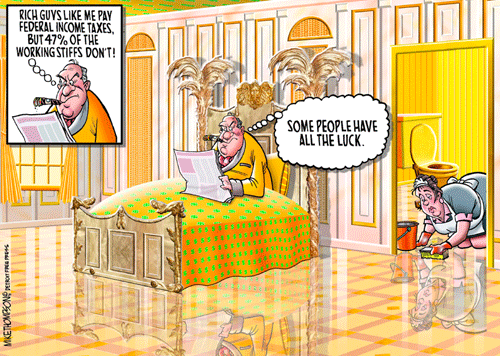
Eugene Robinson runs the numbers:
If Americans were to realize they’ve been the victims of Republican-style redistribution — stealing from the poor to give to the rich — the whole political atmosphere might change.
One more time, Truman was correct.
Poor No More 0

Click for a larger image.
The Fee Hand of the Market 0

Click for a larger image.
Nothing To Do, Nowhere To Go 0
No doubt putting more money in Goldman’s Sacks will fix this.
The Beat Goes On 0
One of the most disheartening things I have learned over the years is that there is far more wife (and husband) beating that goes on–and more persons who turn a blind eye to it–than my very safe and stable upbringing led me to believe.