








“That Conversation about Race” category archive

America’s Racist Fundament 0
At Psychology Today Blogs, Neil Shpancer suggests that incidents of outright racist brutality, such as the recent killings of George Floyd and others for being while black, as horrifying as they are, may distract us from the true character of day-to-day racism. He argues that racism is embedded so deeply within American culture, laws, and public life that it propagates itself, even in the absence of individual acts of overt racism.
Here’s a bit, including four elements he identifies as blinding us to the systemic character of said systemic racism:
(snip)
- First is the process of habituation, by which nervous system activation decreases after prolonged exposure to a stimulus. In other words: things we get used to no longer register. . . .
- Second is internalization, defined as the integration of others’ attitudes, values, standards and opinions into one’s own sense of self. . . .
- Third is learned helplessness, defined as the sense of powerlessness arising from trauma or persistent failure. . . .
- Fourth is the one-two punch of confirmation bias . . . .
(Slightly edited for grammar and clarity.)

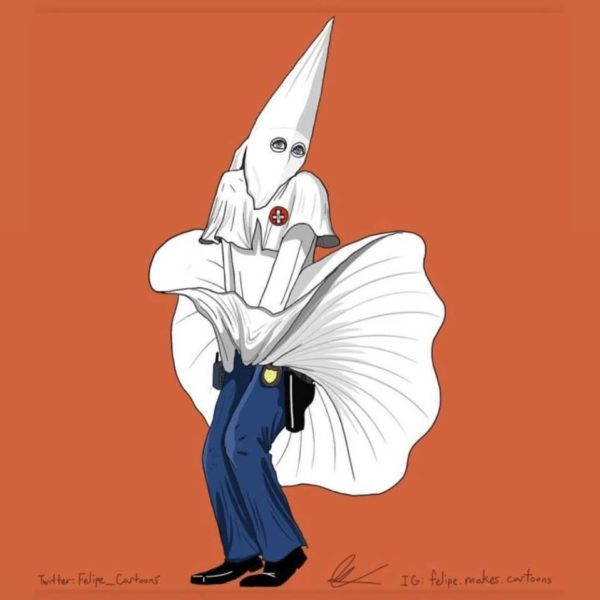
From the “No Self-Awareness” Dept. 0
Bob Molinaro, sports writer extraordinaire, catches the irony:
Slippage 0
I’m a Southern boy.
I grew up under Jim Crow, went to segregated schools, and used segregated facilities for functions that are common to all human beings.
I know from my own experience that the N-word doesn’t “just slip out.”
It’s either part of how you think, or it isn’t.
Monumental Reasoning 0
The Roanoke Times’s editorial board channels Isaac Newton’s third law of motion. A snippet (emphasis added):
For some Virginians, this is a disorienting moment, to the say the least. State Sen. Amanda Chase, R-Chesterfield County, and a candidate for governor next year, took to Facebook to say: “Let’s be honest, there is an overt effort here to erase all white history.” This would be laughable if she didn’t mean it so seriously.
Taking down a statue is not “erasing” history. It’s re-appraising whether we’re honoring the right people from our history.
The Rotting Orchard 0
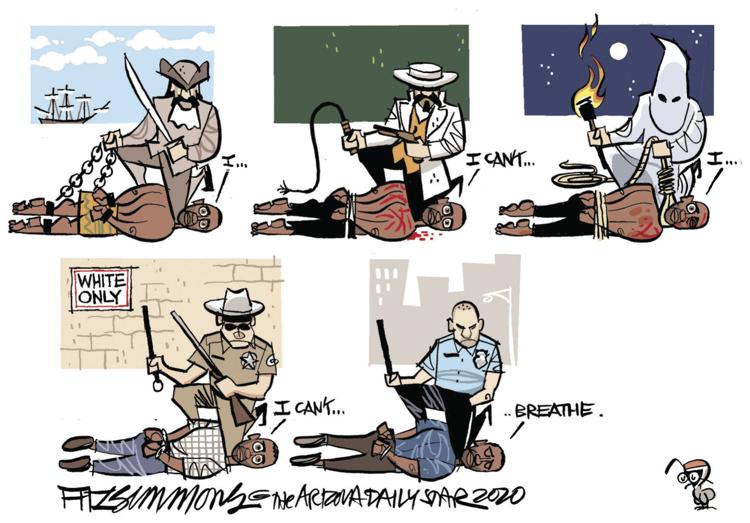
At the Tampa Bay Times, Steven Buckley writes of the killing of George Floyd by Minneapolis police. This passage left out at me:
Follow the link for the complete article.
Righting History 0
Note: When the caller is talking about Greenwood (a neighborhood in Tulsa, Oklahoma) and refers to the “18th and 19th” centuries, he has a slip of the tongue. I am certain that he meant to say either “Eighteen and Nineteen Hundreds” or “19th and 20th centuries.”
Aside:
I think that the had a slip when he referred to , but meant to say “19th and 20th” centuries.

Facebook Frolics 0
Yet another frolicker racisms himself right out of a job.
Addendum:
I disagree with the Elizabeth Dye’s suggestion that this lawyer’s Facebook fail had anything to do with age. Stupidity and racism are independent variables from age.
Descent 0
Will Bunch is less than sanguine.
The Heritage of “Race” 0
The concept of separate and distinct human “races” is a social construct, and a poisonous one. We see evidence of that poison in the headlines every day and most emphatically in recent weeks.
It is also an artificial concept that, less than slightly more than four centuries after its birth, is taken by many as immutable and revealed truth.
At Psychology Today Blogs, Carolyn Purnell offers a brief history of the concept of “race.” I commend it to your attention; it is an especially timely read. A nugget:
Prejudices are as old as humankind, but the concept of “race” is not.
For centuries, the term “race” didn’t refer to humans. Instead, it defined the qualities one wanted in a hunting or war animal (e.g., a fast race of warhorses). By the mid-sixteenth century, the term had crossed over to humankind, but it referred only to the elite. For example, the Capetians were the “third race of kings,” after the Merovingians and Carolingians.
Basically, “race” referred to lineage and inherited characteristics, not to broad human groups.
The first modern use of the term possibly appeared in 1684, in an article by the French doctor François Bernier, but few people read Bernier’s work, and the idea was slow to catch on.
“Race’s” real powder-keg moment came in 1735, when the Swedish naturalist Carl Linnaeus published Systema Naturae.
Aside:
She admits this article is inherently superficial due to its brevity.
Strikingly missing from it, in my view, is sufficient emphasis on the influence of chattel slavery in the Americas, which gave wealthy, influential persons economic incentives to propagate the idea that persons of one skin color were inherently superior to persons of other skin colors.

Southern Strategy Redux 0
Susan Estrich argues that Donald Trump has been waiting for the opportunity to play his own Willie Horton card.
I would counter that he has been playing it continually for forever.