








“That Conversation about Race” category archive
“Outside Agitators” 0
When I was a young ‘un, it was common for segregationists out to perpetuate “Our Way of Life” (TM) to blame the Civil Rights Movement on “outside agitators,” because, natch “our darkies” (as they would say) were happy working for pittances and living in shacks.

“One of My Best Friends Is Black” 0
Jesus, Mary, and Joseph, you can’t make this stuff up.
Still Rising Again after All the Years 0
Pap interviews Chauncey Devega and the racist debt peonage system in Ferguson, Mo. (and other places).
Via We Are Respectable Negroes.
Plus Ca Change 0
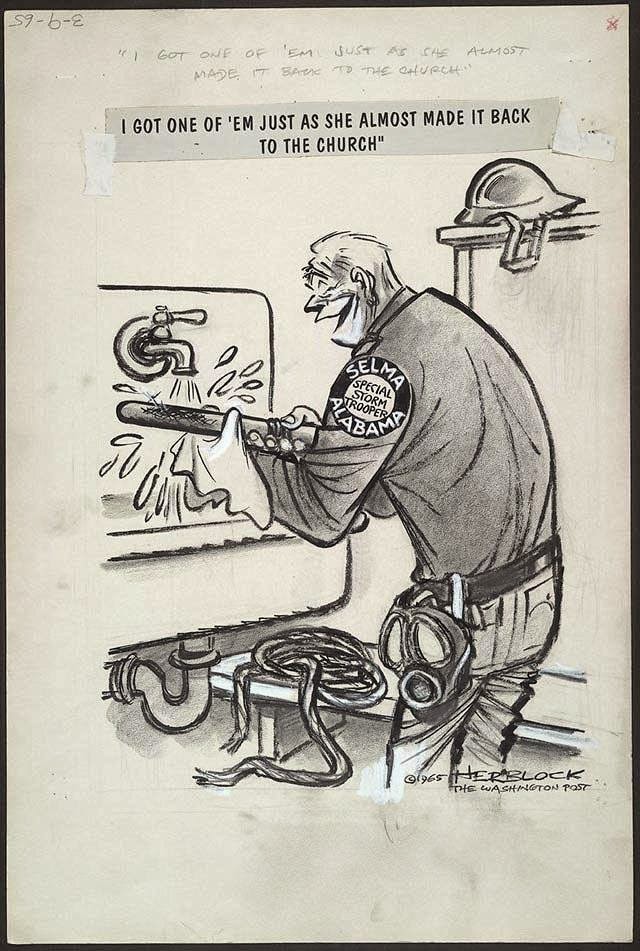
Herblock in 1965 about Selman, but it could be 2015 about Feguson or Cleveland or Seattle or just about anywhere else in these United States . . . .
Via Job’s Anger.
Between the Lines 0
Jim Wright reads between the lines and exposes the racist underpinnings of Rudolph Guiliani’s recent remarks that Obama doesn’t love America “like us.”
Here’s a bit. Do read the rest; it’s a magnificent post.
That’s what plantation owners used to say when they sold black children away from their parents, when they broke up families: they’re not like us, they don’t love their kids like we do.
That’s what we used to say when we sought our Manifest Destiny across the Great Plains. We’re special. Indians? They don’t love America like we do. They can’t love their kids or their wives or their god like we love ours. They can’t, they’re savages.
That’s what we used to say when we burned down villages in Korea and Vietnam, hey don’t feel sorry for them, they don’t feel emotions the way we do. That’s what we say about Muslims in Iraq and Afghanistan. They don’t feel pain or loss, they’re not the same as us, they can’t love their kids or their spouses or their country like we do.
That’s what we used to say when women wanted to vote. Hey, god love ‘em but they just don’t think like we do. They’re not like us, like real Americans.
None Dare Call It Terrorism 0
An article in the Tampa Bay Times reflects on the legacy of Judge Lynch.
These episodes of horrific, communitywide violence have been erased from civic memory in lynching-belt states like Louisiana, Georgia, Alabama, Florida and Mississippi.
The article goes on to discuss the efforts of the Equal Justice Initiative to ensure that the memory of those deeds are not obliterated, however much preserving them may discomfit some Southern white folks who long for the Good Old Days, but will not mention just what it was that makes them think those old days were so good.
Unlike another much-derided New York Times story, which neglected to mention just who did the lynching, the Tampa Bay Times article* does not flinch from identifying the culprits.
Give it a read, then follow the link to the Equal Justice Initiative and read the report or download the Executive Summary (PDF).
________________
*In fairness to the NYT, I think the TBT article may have also appeared there. The TBT does not credit its origin.
Facebook Frolics 0
Chauncey Devega dares tell a truth about the Southern reign of Judge Lynch. Frolicking ensues.
“The Lost Cause” 0
One more time: When you hear someone lament the Lost Cause, ask, “What, precisely, was the cause that was lost?”
Obedience Is Mandatory 0
Anything else will come back to bite you.
This story has been going on for days in my part of the world and I have been trying to figure out how to blog about it, without success; I could not find a handle, because the smell of bigotry overcame me.
If you cannot be safe from the persons who are sworn to keep you safe, you cannot be safe.
The police chief says, “unreasonable.” I say, “racist.”
Selma and the deaths of Goodman, Cheney, and Schwerner were not that long ago. They were within my lifetime, and hate has more lives than a cat.
Victims All 0
At the Bangor Daily News, a little paper with big writers, Alex Stead excoriates white racists’ “victimhood.” A snippet:
Chiksika, the elder brother of Tecumseh, said of white people, “The whole white race is a monster who is always hungry and what he eats is land.” He, of course, said this in response to what he and his tribe had seen of European settlers’ behaviors. Chiksika said to his brother, “When a white man kills an Indian in a fair fight it is called honorable, but when an Indian kills a white man in a fair fight it is called murder. When a white army battles Indians and wins it is called a great victory, but if they lose it is called a massacre and bigger armies are raised.” Whites have long been known for this tendency.
Read the rest and, the next time you hear a white folk whining about “those people,” have your grains of salt ready.
An Awakening 0
A Republican travels to China and discovers the reality of white privilege in America. Here’s a bit; read the rest.
I recently traveled to China on business, joined by a colleague on his first visit. We are both white males, yet my travel companion stands out in the crowd. Local citizens flocked to capture a glimpse and snap pictures of his towering 6’ 5” frame, blonde hair and blue eyes. While I expected a reaction from the local crowd, I wasn’t prepared for a very new experience: the benefit of the doubt I have always enjoyed vanished.
All the News that Fits 0
The tape doctors:
Fox lies. It’s how they roll.
The Colorbind Society 0
Writing at the Bangor Daily News, Sociology Professor Michael Rocque explains that, despite the denials you hear, of course it’s about race. A nugget.
Chattel slavery, justified by a mythology of racism, is America’s original sin. As with any sin, denying it does not make it go away.
Do follow the link. Granted, the man needs an editor, but what he says needs hearing.

