








Weather, or Not category archive
Denial Is Not Just a River in Egypt (Updated) 0

Addendum:
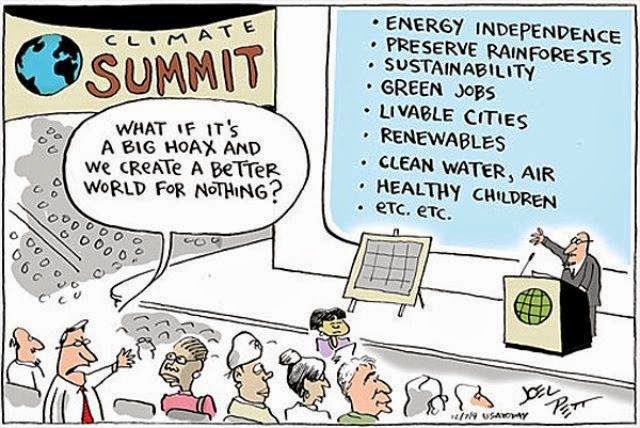
Elsewhere, Bob Cesca looks at the big picture. A nugget:
Image via Bob Cesca’s Awesome Blog.

This Is Not Right 0
78 Fahrenheits two days before Christmas.
That’s okay in San Diego. Not here.
Climate Change 0
Yesterday, the high here was 77 Fahrenheits. In December.
We turned on the AC. In December.
One of my potted roses is budding. In December.
The daffodils are sprouting. In December.
Move along, though. Nothing to see here.
Not this December.
Everybody Must Get Fracked 0
The burning drinking water is not the only problem, perhaps not even the main one. Joe Nocera:
It is well established that when natural gas is combusted, it has both environmental and climate change benefits — starting with the fact that natural gas emits half the carbon of coal. But that advantage disappears when too much methane leaks during any part of the production process.
According to the Environmental Defense Fund, “Methane is at least 28 times more powerful than CO2 as a greenhouse gas over the longer term and at least 84 times more potent in the near term.”
More at the link.
By the way, the high here Monday was 73 Fahrenheits. In the middle of November.
My friend, who has lived in these parts for a long time, doesn’t really notice it because of having adjusted gradually, but I, who moved away and then came back, can attest that that is just not right.
Drear 0
Today is the eighth straight day of unrelenting clouds, rain, and drizzle.
The clouds parted yesterday evening, but it was merely a cruel joke to get our hopes up. They unparted during the night.
I can’t recall a stretch of such unrelenting dreary weather.
Washout (Updated) 0
It’s been raining since Tuesday.
I looked at my rain gauge, which has a capacity of 5.25 inches, this morning.
It was full.
Addendum, Later Same Day:
Another .75 inches today.
Cheeseheads 0
Here’s a slice of news.
A report prepared by the city’s Department of Public Works notes that Milwaukee, like most cities, relies on rock salt as its primary de-icer on roads. Rock salt, according to the report, is plentiful, inexpensive and very effective.
Denial Is Not Just a River in Egypt 2
At Psychology Today Blogs, two psychologist try to understand America’s failure to face the reality of climate change and to what extent even thinking about the possibility thereof may have become a societal taboo.
A nugget:
Mary: One reason Americans don’t talk about this is because we don’t get good information. For twenty years now the culture has been mired in the least productive of all topics, which is “Do you believe in climate change?” It’s as if we were talking about whether or not we believe in extraterrestrials! Climate change is no more a matter of belief than microbes are a matter of belief — it’s an empirical fact based on evidence provided by international scientists.
Dry Hole 0
Lake Powell used to be Glen Canyon. I’ve gone rafting down river from it.
Groups urging conservation warned of drastic water cutbacks and severe economic implications, while state officials and the Central Arizona Project sought to downplay the alarm.
Looks like it’s on the way to once again being just plain old Glen Canyon.
Driving while Dunk 0
Beating the heat on the autobahn . . . .
(snip)
But there’s one question that even police experts have been unable to answer: Is it illegal to drive a swimming pool?
Poolside photos at the link.
Global Warming Is a Hoax, Except Reality 0
A rising tide floods all houses.
Currently, homes built in such areas must be built 1 foot above where floodwaters can rise. The higher elevation would bring the requirement up to 3 feet and is one of several changes proposed.
City staff originally pushed for an increase to 2 feet last year, but a rise in the sea level caused the Planning Commission to go higher, Vice Chairman Martin Thomas Jr. said. Already, the city has seen a dramatic increase in the number of properties with recurring flood damage.
Twister 0
Via the San Jose Mercury-News, footage of a tornado in Italy. It’s below the fold because it autoplays.
Dust Bowl Days 0
California prepares to relive its storied past.
For nearly a century the state has been taking snow measurements at select areas across the Sierra Nevada in an attempt to gauge how much water will be available for farmers and city dwellers. Having a course bare of snow is not unheard of in May – the last month it is measured – but it’s another stark reminder that water will be in short supply this summer.
With the DWR projecting to supply just 35 percent of what 29 agencies providing water to 25 million Californians say they need, officials still are not ready to call it a drought.

For grins and giggles, here’s a bit of what Richard Henry Dana had to say about Los Angeles.
Stray Thought 0
We seem to have gone from March to July in three days.
Nor Any Drop To Drink 0
Colorado water utilities imposing severe limits on using water for ornament watering lawns.
More dryness at the link.
Dry-Gulched 0
MarketWatch’s Eric Holthaus wonders whether the Dust Bowl is returning.
Consequences could be disastrous for farming and ranching communities across the Midwest — and lead to another spike in commodities prices should yields again suffer. . . .
The U.S. economy is still only starting to process last year’s drought. On the consumer side, recent government reports confirm that food prices have just begun to rise due to last year’s drought that — at its peak last September — covered nearly two-thirds of the country. Though hot weather and lack of rain caused futures prices for corn and soy to peak at new record highs last August, a lag in the country’s agroprocessing system means consumers — and therefore the broader economy — won’t feel the full brunt of higher supermarket prices for meat, dairy, and grains until later this year.
Much more at the link.
Climate Ch-Ch-Changes 0
-
Something’s happening here.
What it is ain’t exactly clear.
But there must be some reason that the Miami (as in Florida) Herald would carry a column about decorative cold weather plants suitable for Virginia.
The Name Game 0
Friday night, we tried checking on the New England snowmageddon on the Weather Channel, but, the third time the announcers referred to the storm as “Nemo,” we signed off in disgust.
Too stupid for words.
Signs of the Times 0
Daffodils. February. Really.
