







Author's archive
A Diet of Worms 0
Warning: Language.

Billions for Bullets 0
At the Boston Review, takes a look at arguments for increasing defense spending not just wanting, but spectacularly specious. He makes some points that are commonly absent from the discussion and deserve consideration. Here’s a snippet:
A larger flaw in McCain’s argument, however, is that, by historical standards, not much is actually burning. And, more importantly, the United States does not need to go looking for fires to extinguish. The world remains far more peaceful by various measures than at almost any other point, and the United States still enjoys a privileged position: militarily powerful and distant from trouble. U.S. enemies are historically few and weak; U.S. defense spending is more than double what Russia, China, Iran, and North Korea collectively spend on their militaries; and U.S. forces remain vastly superior. North Korea and Iran are troublesome, but incapable of posing much direct threat to their neighbors, let alone the United States, especially considering nuclear deterrence. Russia threatens its neighbors, but with an oil-dependent economy now about the size of Italy’s, it poses little danger to more economically stable nations further west.
A Picture Is Worth, the Art of the Con Dept. 0

Dick Polman comments on the notion that you can “run the government like a business”:
I marveled at this naivete for two reasons: Trump was a terrible role model, having been bailed out of six bankruptcies by a dwindling number of indulgent investors; and there’s no historical record of any businessman successfully running America as a business.
The sole career businessman ever elected to the presidency was mining magnate Herbert Hoover. He was touted in 1928 as a problem-solver who’d bring his engineering skills to the public sector. You know what happened next. The stock market crashed, and as the Great Depression deepened, Hoover made things worse because he couldn’t communicate, cajole, compromise, or inspire. He fatally lacked the political skills required of a president.
More Polman at the link.
Image via PoliticalProf.
Misty Water-Colored Memories 0

Click for the original image.
If One Standard Is Good, Two Must Be Better 0
 In these parts, there have been several instances of black persons imprisoned for minor, almost miniscule crimes, dying in jail from neglect, with this being perhaps the most unspeakably egregious case.
Meanwhile, a rich white banker convicted of bribery and bank fraud gets a “Get Out of Jail Free” card because he has high blood pressure.
The editorial cartoonist for my local rag is not amused.
“An Armed Society Is a Polite Society” 0
Rear your children politely.
They say the 6-year-old came across her father’s handgun and accidentally fired it.

Guns and stupid, guns and stupid,
They go together like a horse and carriage.
This I tell you brother,
Mix them together to make your carnage.
Second Thoughts? 0

I fear not enough persons are having them.
Mythbuster 0
The Rude One marvels at Trump’s fact-free interview with Time Magazine. Here’s a snippet (emphasis added, warning: language):
When someone believes their own mythology, they become parodies of themselves. Trump has never not been that parody, and now, as his supposedly legendary dealmaking ability falls to pieces in the health care bill debacle, he is frantically trying to maintain the illusion of the myth. Without that myth, he’s just a sad old man in an ill-fitting suit who wants to play truck driver.
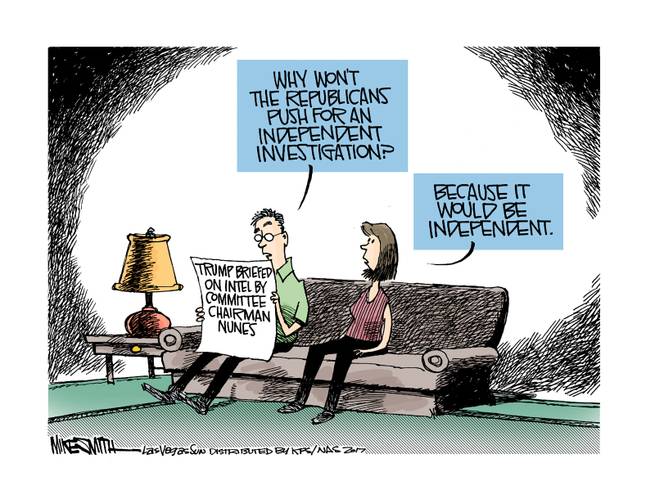
Stop the Pressers! 0
In The Roanoke Times, history professor Robert A. Strong recounts examples of lies from various Presidential administrations from Eisenhower (denying spy flights over Russia) through Kennedy (denying having Addison’s disease) through Carter (denying planning military action to rescue the hostages in Iran) through Reagan through Clinton and so on. He points out that the lies have generally ranged from national security issues to campaign promises to personal issues, but that they stopped short of denying objective reality that was in public view.
He maintains that Trump’s lies are different in both degree and kind (emphasis added).
In a piece that eerily covers the same ground, Der Spiegel suggests that Trump is more interested in freedom of propaganda than in freedom of the press.
McCurry believes that Trump would like to curtail press freedom. “If he could issue an order that the only coverage allowed of him was positive, he would do so without delay.”
History 0
I’m a Southern Boy. I grew up under Jim Crow and went to segregated schools, as I have mentioned from time to time in these electrons. I had ancestors who owned slaves. My degree is in history with a concentration in U. S. Southern.
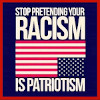
As I’ve added experience to my studies, I have more and more concluded that race and racism are constant undercurrents (and sometimes overcurrents) in American politics, however energetically white Americans try to pretend otherwise.
A half century ago, Richard Nixon’s odious Southern strategy caused the Republican Party to morph into the party of racism and bigotry.
Nixon thought that he could use Southern bigots and racists to cement his power (that worked out very nicely, did it not?); now, half a century later, his strategy had come full circle and the powers that he invited into his party have consumed it. Bigotry and racism are fundamental elements underlying Republican polices and positions, central elements to their campaign strategies.
This week, the results of Nixon’s decision to open Republican doors wide to racists played out quite publicly in Republicans’ failed attempt to “repeal and replace” the Affordable Care Act, the health care law that Republicans chose to refer to as “Obamacare,” for reasons that Atrios summed up brilliantly yesterday so I don’t have to.
Trumpling Freedom of Religion 0
(Link fixed.)
In The Seattle Times, Rabbi Daniel Weiner reflects on the recent anti-Semitic vandalism of his synagogue, in which the words, “Holocau$t is face hi$tory,” were spray-painted on its wall. He responds to persons who believed that he unfairly blamed Donald Trump for the deed. Here’s an excerpt (emphasis added):
There has been much documented about the intersections between Trump associates and the “alt-right” — a cleansing euphemism for white supremacy. Trump’s actual regard for vulnerable populations, Jews among them, is inconsequential to his intoning of the classic “dog-whistles” of anti-minority tropes. If he is truly aware of the implications of his words, it is troubling. If he plumbs the abyss out of mere political expediency, it is equally dangerous, displaying a reckless disregard for truth and propriety unworthy of the office he currently holds.
When you blow a dog-whistle, don’t be surprised when the dogs respond.
Projecting the Loss 0
At Psychology Today Blogs, Stanton Peel returns with another post about Donald Trump; Peele argues that Trump’s reaction to Republicans’ pulling their “they laughingly call it a health care” bill is a classic illustration of psychological projection.
Here’s a bit:
Um, Mr. President? No votes were taken with Democrats present.
Psychological projection is a syndrome in which humans defend themselves against their own unconscious impulses or qualities by denying their existence in themselves while attributing them to others.
Donald Trump’s speech on the defeat of the health care bill he supported was a model of projection.
Do please read the rest.