








Author's archive
Both Sides Don’t 0
Llewellyn King suggests that the current model for American journalism may not be–er–optimal. A snippet:
You can’t give the lie the same credence as the truth or you will hide in false equivalence and fail the public.

Sauce for the Goose . . . 0
The Orlando Sentinel’s Scott Maxwell has a modest proposal. A nugget:
I have a better idea:
Let’s force legislators to strap on body-cams and mics on themselves every time they’re around lobbyists.
Follow the link for his reasoning.
Vaccine Nation 0
The Des Moines Regisster’s Rekha Basu takes a look at the recent Supreme Court decision nullifying OSHA’s regulation requiring employers to take reasonable steps to combat COVID-19. A nugget (emphasis in the original); follow the link for the rest.
Isn’t that what COVID itself is doing? . . . .
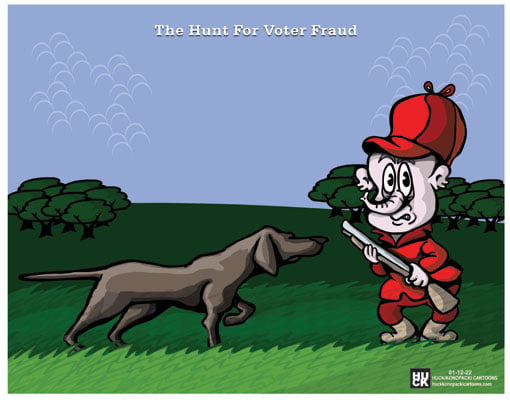
Gutting Out the Vote 0
Excerpt:
They (Republicans–ed.) talk about winning the battle of ideas. They have lost the battle of ideas. . . . They are winning with gerrymandering, they are winning with making voting difficult . . . .
Warning: Short commercial at the end.
See the news report that David discusses.
“An Armed Society Is a Polite Society” 0
Exercise politeness in resolving disputes upon the nation’s highways and byways.
Break Time 0
Off to drink liberally.
The Tip-Off 0
It’s not a good idea to stiff your server.

Vaccine Nation, Words Fail Me Dept. 0
Honest to Betsy, you can’t make this stuff up (and you wouldn’t want to). Warning: Short commercial at the end, but you can skip it if you want to. But honest to Pete and Betsy both . . . .
We are a society of stupid.

Originalist Sin 0
Robert Reich argues that the self-styled Constitutional “originalists” would have to find that the filibuster is contrary to the original intent of the Founders. Here’s a bit of his argument; follow the link for the full article, in which Reich delves into the racist origin and evolution of the filibuster.
This led James Madison to argue against any super-majority requirement in the Constitution the Framers were then designing, writing that otherwise “the fundamental principle of free government would be reversed,“ and “It would be no longer the majority that would rule: the power would be transferred to the minority.” And it led Alexander Hamilton to note “how much good may be prevented, and how much ill may be produced” if a minority in either house of Congress had “the power of hindering the doing what may be necessary.”The Framers went to great lengths to ensure that a minority of senators could not thwart the wishes of the majority. After all, a major reason they convened the Constitutional Convention in 1787 was because the Articles of Confederation (the precursor to the Constitution) required a super-majority vote of nine of the thirteen states, making the government weak and ineffective.
Methinks he makes his case.
Nevertheless, I think Reich’s argument will fall on deaf ears from the “originialists,” who show great ingenuity in redefining the Founders’ “original intent” when it suits their ends. Indeed, one can make a strong argument that the only bit of “original intent” to which “originalists” are truly committed is the 3/5s clause.