





From Pine View Farm

Political Theatre category archive

Credo 0

At the Idaho State Journal, Leonard Hitchcock posits what he believes to the underlying principles of the dominant faction within today’s Republican Party.

Follow the link to decide whether you think he’s onto something.

Share

The Blame Game 0

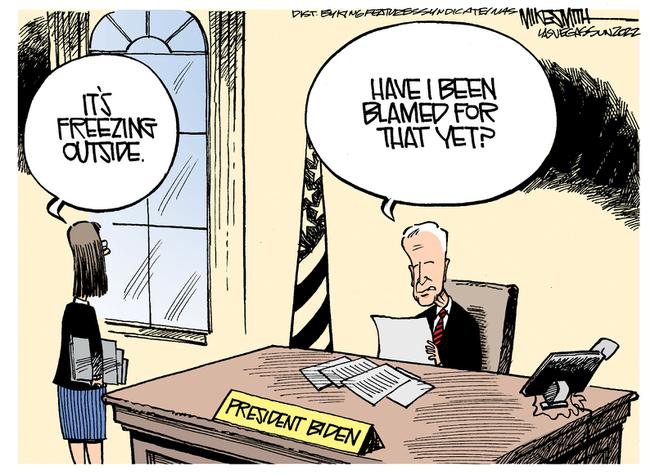
Staffer to President Biden:  It's freezing outside.  Biden:  Have I been blamed for that yet?

Click for the original image.

Share

The Election Thief 0

Seth discusses Donald Trump’s plan to confiscate voting machines after he lost the 2020 election.

Share

A Tune for the Times 0

Share

A Trumpled Democracy, Reprise 0

Share

A Trumpled Democracy 0

Title:  New Democracy Island.  Image:  Man on desert island to second man who is wearing a horned hat and holding a torch:  Whoa, whoa, whoa . . . It's my turn to launch and insurrection.

Click to view the original image.

Share

The Great Pretender 0

Title:  Trump Truth:  The King's Speech in the Emperor's Clothes.  Image:  Donald Trump, dressed in royal robes, looks at a crown labeled

Click to view the original image.

Share

All the News that Fits 0

Robert Cramer, writing at Psychology Today Blogs, offers a primer on identifying and avoiding being taken in by–er–bovine patties.

Share

Role Models 0

F. T. Rea suggests that comparing Donald Trump to Twentieth Century fascists may be the most accurate analogy. Rather, he suggests that Trump’s behavior is more like a more home-grown American phenomenon–the urban political boss (think Boss Tweed). Here’s a snippet; follow the link for the complete article.

While they are similar, fascism and bossism are not exactly the same thing and Trump doesn’t know or care much about ideology. However, just like Johnny Rocco, the gangster, played by Edward G. Robinson, in “Key Largo” (1948), Trump always wants more and he will never get enough.

I think he makes some good points as regards understanding Donald Trump’s own impulses; he is the poster boy for Me! Me! Me!. But autocracy is autocracy, and autocracy is their end.

Share

Recommended Listening 0

Bob Cesca’s interview with Brian Karem.

It helps illuminate dis coarse discourse.

Share

“The Absurd Interpretation” 0

David talks with Elizabeth Coppock, Assistant Professor of Linguistics at Boston University, about texts and context.

Share

Majority Rule 0

PoliticalProf runs the numbers.

Share

An Unholy Alliance 0

Frame One:  Donald Trump says,

Click to view the original image.

Share

The Disinformation Superhighway 0

At Psychology Today Blogs, Paul Thagard argues that the success of fascist movements depends on misinformation. After outlining five specific types of misinformation that fascist movements of the 20th Century relied on, he goes on to suggests practices for inoculating ourselves against mis- and disinformation.

What particularly caught my eye, though, was this nugget, which illustrates why “social” media isn’t (emphasis added):

Misinformation spreads because politicians exploit people’s susceptibility to motivated inference and thought-distorting emotions such as fear, anger, and hatred. Early twentieth-century fascists could only spread misinformation slowly, through print, radio, movies, and rallies, but today misinformation is rapidly and effectively transmitted by social media such as Facebook, Twitter, Instagram, and YouTube, whose algorithms value emotional engagement and advertising revenue over truth and democracy.

I commend the article to your attention.

Share

Seen on the Disinformation Superhighway 0

Snopes rounds up a herd of hooey about presidents and presidential candidates from the past three decades and concludes

Based on that fact-checking experience, it’s safe to say that a decentralized network of internet users with a fifth-grade sense of humor — as well as some meme-ing, video-editing or photoshop skills — are among the leading forces behind rumors that try to harm presidents’ reputations by accusing them of avoidable mishaps. The content creators’ exact intentions are sometimes unclear, and we have yet to find evidence to show that any one of them consider their “joke” part of a broad trend in polluting our media ecosystem.

Follow the link for details.

Share

A Tune for the Times 0

Share

Gutting Out the Vote 0

Thom talks with the Brennan Center’s Michael Waldman about partisan (that is, Republican) efforts to restrict voting rights.

Share

Courting Disaster 0

Methinks Noz has a point.

Share

Misdiagnosis 0

Joe Pierre, writing at Psychology Today Blogs, looks at dis coarse discourse and argues that attributing belief in political or scientific fairy tales to “mass delusion” or “mass psychosis” is, as my old boss used to say, “in error.” Rather, he suggests that such beliefs are symptomatic of a sick society, not of sick individuals.

Here’s a bit of his piece (emphasis added); follow the link for the complete article.

Although there’s a long history of misusing psychiatric terminology more loosely as a pejorative, this hardly justifies the act today in responsible journalism, politics, or civil public discourse. Besides being technically inaccurate, using terms like “delusion” and “psychosis” to “other” those whose beliefs we find objectionable or unfathomable unfairly stigmatizes those who suffer from actual mental illness. Furthermore, invoking clinical terms to dismiss our ideological opponents does us all a disservice by steering away from understanding and addressing the real root causes of false beliefs related to politics and scientific matters that have become politicized which are more appropriately categorized as conspiracy theories.

Aside:

I would argue that the ultimate “real root cause”–to use his term–of our present poisonous politics is America’s original sin of chattel slavery and the racist ideology created to justify and excuse it, which is perpetually promoted by political actors for power and profit.

But that’s just me.

Share

Willfully Ignorant 0

Joe Manchin, standing in front ot the Capitol, which has comets labeled

Click to view the original image.

Share