








Political Theatre category archive

Buyer’s Remorse 0
Shorter Erika D. Smith: You get no sympathy from me.


No More Classes, No More Books, No More Teachers . . . . 0
In a lengthy essay, Alan Taylor looks at the place of education in United States history. He points out that, by and large, the founders believed strongly that an educated citizenry was essential to the survival of the new nation and pushed, sometimes with more success, sometimes with less, to make learning more available. Ultimately, this resulted in a strong system of public education.
He fears this trend has reversed, as school budgets are cut back, college students are laden with debt, class-sizes increase, and public systems of higher educations are being starved for funds. Here’s bit from the essay; follow the link for the whole thing (emphasis added).
Although the current definition of education is relentlessly economic, the source of the crisis is political. Just as in Jefferson’s day, most legislators and governors believe that voters prefer tax cuts to investments in public education. Too few leaders make the case for higher education as a public good from which everyone benefits. But broader access to a quality education pays off in collective ways: economic growth, scientific innovation, informed voters and leaders, a richer and more diverse culture, and lower crime rates—each of which benefits us all. Few Americans know the political case for education advanced by the founders. Modern politicians often make a great show of their supposed devotion to those who founded the nation, but then push for the privatization of education as just another consumer product best measured in dollars and paid for by individuals. This reverses the priorities of the founders.
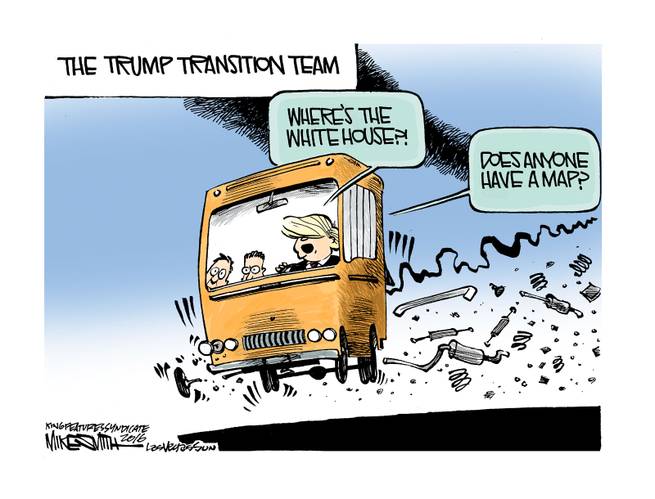
Trumpling the Privatization Scam 0
These people do not believe in the existence of a common good.
Dis Coarse Discourse 0
Will Bunch, who is definitely one of the good guys (I have one of his books), muses on what’s wrong with reportage. His conclusions may not be what you expect. A snippet (emphasis added):
Many of the journalists and outside critics who’ve talked about the failures of journalism since Trump’s election have touched on some or all of these factors. But most of the media criticism has come up bone dry when it comes to solving these problems — because almost all of this conversation takes place in the tiny, suffocating box of stale journalism ideas that have slowly been choking the profession for decades.
Interregnum: Is Is the End of “The West”? 0
Der Spiegel wonders who will will the void. A nugget:
One hundred years later: Trump.
Trump, who wants nothing to do with globalization; Trump, who preaches American nationalism, isolation, partial withdrawal from world trade and zero responsibility for a global problem like climate change. And all of this after a perverse election campaign marked by resentment, racism and incitement.

Picture This 0
Job’s Anger has a round-up from around the world of editorial cartoons about the election. Go visit.
“Laboratories of Democracy” 0
It is sometimes said that, in the U. S., states are the laboratories of democracy. Peter St. Onge suggests that, if that’s the case, take a look at North Carolina.
Facebook Frolics 0
There’s another word for “fake news,” y’know. When I was a young ‘un back in the olden days, we called it “lies.”
“I Know I Am but What Are You?” 0
At Psychology Today Blogs, Jeremy Sherman dissects the Republican Party’s electoral strategy–repetitive fact-free discourse. A snippet:
(snip)
“This guy doesn’t think. He just automatically says whatever makes him sound infallible.”
“That’s not true.”
“See, he did it again.”
“No, you’re the one who makes stuff up.”
“There he goes, like a robot turning every challenge back on the challenger.”
“I’m not doing that. You are.”
“There it is again. See that, folks?”
“Well, you do it too.”
“Always defensive.”
“I am not!”
“See that? He’s proving my point.”The no-growth formula is their MO, their only trick, their one-size-tricks-all, wall to wall formula.
He goes on to argue that, against such thinking, facts are useless, which, I suppose, has been borne out by events. For example. (Regrettably, he does not suggest an effective approach beyond “wait it out.”)
The System Is Gamed Gamey
0
Last week, Paul Krugman argued that the election was rigged, but not by who you might have thought.
This week, Dick Polman explains how the system has been rigged from the git-go.