


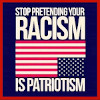





“That Conversation about Race” category archive
Taking Inaction 0
In a longer piece about the implications of blackface and the recent revelations in Virginia, the Portland Press-Herald’s Greg Kesich makes a vital observation (emphasis added):
The real problem is much bigger and more complex. All of us were brought up in a racist world – not of our own making, but built on deep inequality that started with slavery and never ended. You don’t have to have hatred in your heart to perpetuate this system. You just need to pretend that you didn’t notice it.
I agree wholeheartedly with him that inaction in the face of evil is culpability.

No Excuses 0
In the Portland Press-Herald, Donna Edwards argues that the racist nature of blackface was old news a long time ago.
The stupid. It burns.
Driving while Black 0
Honest to Betsy, you couldn’t make this stuff up.
I can’t summarize or excerpt it in any meaningful way. Just follow the link.


Tales of the Trumpling: Snapshots of Trickle-Down Trumpery 0
Afterthought:
I did a year of grad work (History, U. S. Southern) at U. Va. I had a couple of great professors, one so-so one, and one so bad that his book got remaindered under his nose right there in C’ville.
I learned one thing in particular: A love for the study of history is not ipso facto a qualification for becoming a professional academician.

Misdirection Play 0
Pamela Person has some questions.
Follow the link for her answers.
Tribes and Tribulations 0
Mike Brooks suggests that the tribalism of our contemporary politics is rooted in humans’ evolutionary past. He points out that, until very recently in the sweep of history, humans lived in tribal groups of up to a couple of hundred persons. Even when persons were absorbed in the realms of empires and kingdoms, day-to-day transactions were confined to villages with few inhabitants. He suggests that Donald Trump’s desire for a border wall both symbolizes is fed in part by a toxic hyper-tribalism. A snippet:
(snip)
In one sense, it can be okay to take some pride in this affiliation (e.g., “I’m proud to be an American,” “I love my university”). However, it’s easy to slip into tribal, us vs. them mentality when we start saying versions of “me and my group are better than you and your group.” Arguably, this is how patriotism (e.g., “I love my country”) can turn into a more tribal nationalism (e.g., “my country is the best/greatest”). A look back through history (e.g., Nazi concentration camps, genocides, slavery, ethnic cleansing) offers hard lessons about what can happen when hyper-tribalism runs amok.
I commend the entire article to your attention.
