








“That Conversation about Race” category archive
Ferguson 0
Jasiri X raps Ferguson. I used to think that they left the “c” off of “rap,” but he has convinced me otherwise. (Warning: Language.)
From the website:
Full lyrics at the link.

“Murder Is Still Murder” 0
Being while Black 0
It would appear this his only crime was being while black.
Chauncey Devega’s post on the killing and its aftermath is excellent. It defies summary or excerpting. Just read it.
Predictive Algorithms 0
In case you wondered, racism can indeed be implemented with mathematics.
Guilty! Guilty! Guilty! 0
This is the girl who was shot to death because she sought help after a car accident.
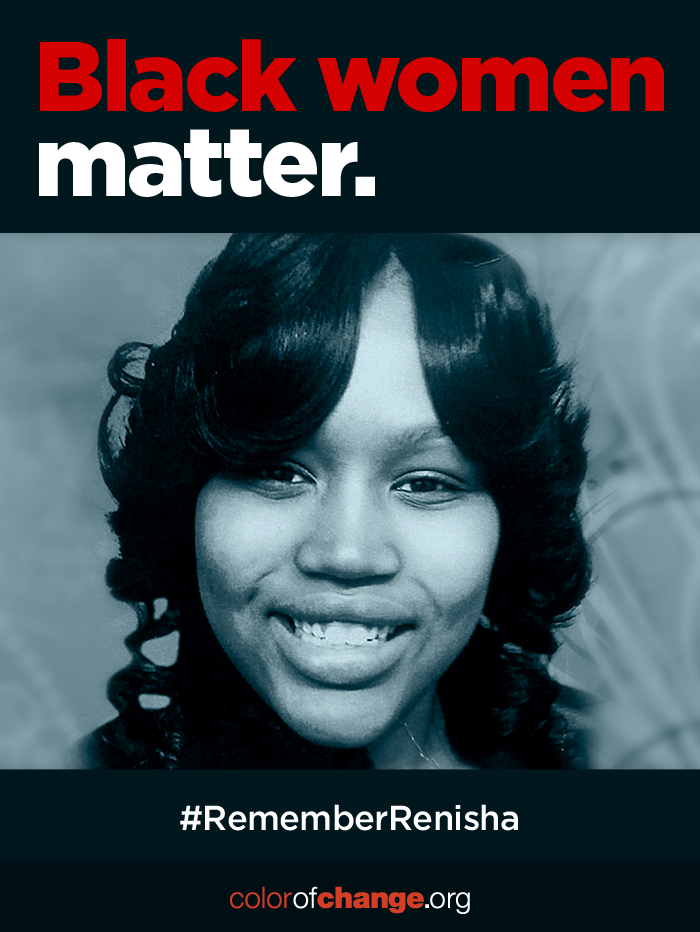
From Color of Change
A jury has just found Theodore Wafer guilty on all counts for the murder of 19-year-old Renisha McBride, who was tragically killed when seeking help after a car accident in the Detroit suburb of Dearborn Heights, MI.
Wafer’s conviction is an incredibly important and rare moment of accountability for violence against Black women. Share the powerful above image to honor Renisha and help grow the movement to end violence against Black women.
She was murdered for the crime of seeking help while black.
Image and statement via Color of Change.
Myth-Makers: How the South Won the Civil War 0
The North may have won the war, but the South won the peace.
The myth of the nobility of the Lost Cause and of its proponents was part of its winning strategy. The tales of gracious Southern hospitality, of kind masters and happy slaves, were essential to building the myth. Gone with the Wind was the myth-builders’ apotheosis, their master-stroke, myth-making on the grandest scale. Even more corrosively, it was a myth devotedly believed by its proponents in their desire to absolve themselves and their ancestors from the evils they had perpetrated.
I’m sure that my ancestors, many of whom wore the gray and some of whom held slaves, were mostly good people as best they knew how (except for Henry Alexander Wise, who may have been single-handedly the most important individual in convincing Virginia to secede), but Southerners’ romanticizing slave-holders, slavery, and those who fought to perpetuate slavery and “Our Way of Life” must end before the South finds redemption.
A way of life built on blood and torture and rape and theft of labor must be no longer romanticized, no longer admired, no longer remembered with wistful tears nor with misty water-colored memories. It was not romantic when it happened to the sound of whips and the clank of chains; it warrants no wistful tears, no water-colored memories. Until Southerners confront and admit this, their–our–sin will not be purged.
But it’s not going to happen, is it?
Far too many of our countrymen want “those days” back. For sake of economy, we’ll call them “Republicans,” as Nixon’s odious Southern Strategy, by which he expected to entice bigots to support the Republican Party, has come full circle, so that bigots now control the Republican Party.
So long as some of our fellow citizens look wistfully to the Old South as a promised land, America’s original sin of slavery will continue to soil the polity and America’s soul.
Afterthought:
If you want to walk back into the myth of genteel racism, try watching Disney’s Song of the South. Except for the cartoon bits, it’s little more than racist propaganda, full of kind masters and smiling happy darkies singing in the fields.
My friend and I watched it a while ago. The “live action” scenes took all the fun out of the cartoons. It was, quite frankly, to gag.
You Have These Thoughts 0
If you are white, you do. I do–not nearly so often as I used to, but still occasionally–and I kick myself when I do because I know it’s my Virginia heritage and not my humanity talking.
The Milwaukee Journal-Sentinel’s Peggy Schultz has the guts to admit it. Do you?
After all, nothing is more American than racism.
Follow the link; read the rest.
Tradition 0
News item:
When I was a young ‘un, back in the olden days, growing up under Jim Crow, we referred to black persons as “colored.” It was the polite word. My South Carolina grandmother, born in 1900, always called black persons “darkies”; she thought it impolite to remind them that they were black (as if they didn’t know it).
(I heard the N-word from my father’s lips only once: we were watching a football game and Paul Warfield was racing for a touchdown. My father leapt from his chair saying, “Look at that [N-word] run.” We were raised to know that that word was, at best, rude.)
I was young and unaware. Now I’m old and at least somewhat aware. I’m a Southern boy, and I know bigots–and bigotry–when I see them.
Many years later, referring to Jim Crow, my father said, “I’m glad those days are gone.” But those days aren’t gone. Jim Crow keeps trying to make a comeback. And Jim Crow has many companions, among them Dan Snyder and his acolytes (and the Republican Party, but that’s a different post), who think that “Redskins” is not a slur. (Full Disclosure: I have a “Redskins” mug purchased many years ago, when I lived in Northern Virginia and Washington, D. C., had a professional football team. Awareness is not a one-time thing–it’s a process. It just went in the trash.)
Those days will not be gone until persons who consider themselves “respectable” realize that defending bigotry and bigoted behavior in all its forms is not only not moral, but not “respectable,” until they realize that tradition is not a defense for hate-fullness. The Rude One expresses this rudely, but effectively.
Invoking tradition in the defense of bigotry is dressing bigotry in Sunday-go-to-meeting clothes, nothing more.

Follow the link to the image. Read the comments. They are a lesson in how bigots rationalize bigotry.
Alpha Male 0
He couldn’t get a girlfriend.
So he killed girls, and, as Chauncey Devega predicts, no notice will be taken.
I got nothing. Just follow the link.
Belle 0
Yesterday, we went to see the movie, Belle, at the Naro (the Naro is a gem and a treasure).
You should see it too. It is much better than most critics seem to think; the critics seem lukewarm because the characterization is not complex enough for their refined tastes, the issues are too black-and-white (you will pardon the expression) for their complex minds, but, frankly, they miss the point. They are dissecting the movie as a movie, as some stand-alone thing, without context. The movie, for all that it is a movie, lives in today’s world; it brings alive issues of race and racism, subjugation and injustice, bigotry and exploitation, that live still, issues that are, indeed, black and white. Nothing illustrates this better than that one American political party still today exploits race and racism, subjugation and injustice, bigotry and exploitation to maintain its existence and fill the coffers of its candidates.

Portrait of Dido Elizabeth Belle and Lady Elizabeth Murray
Know, though, that it is not a documentary. It is “based on a true story,” but it is not a true story. After all, it’s a movie, and one that is not all comic book heroes and CGI and remakes and silly sex jokes (those qualities suffice to make it an exception in these days, as the movie industry seems rarely capable of coughing up anything other than comic book heroes, CGI, remakes, and silly sex jokes). A “fictionalized” narrative of the real Belle is shoe-horned into a narrative about an insurance court case over the slave ship Zong, in which the crew of the ship tossed their “cargo” over the side of the ship so they could collect the insurance on the lives of the chattels–that is, items of property, such as chairs and tables–tossed them over the gunwales as if they had been chairs and tables.
Little is actually known about the real Belle. If you are interested in her, perhaps the best starting point is this post by Henry Louis Gates.*
____________________
*Remember Henry Louis Gates? He was the Harvard professor who was rousted by the cops for coming home while black.
The Second Deconstruction 0
When I was a young ‘un, back in the olden days, there were not cops in schools. Now, they are a fixture and they show that the school to prison pipeline is a real thing. Let the ACLU explain:
This extreme approach – which includes the overly strict enforcement of zero-tolerance policies, the use of suspension and expulsion at younger and younger ages, and increasingly turning students over to law enforcement – has resulted in a skyrocketing number of students receiving harsh punishments. Much of the increase is the result of heightened concerns over school violence, even though research shows there is no safer place for kids than in school. Another factor is the persistent misperception that students of color are inherently more dangerous.
When kindergärtners are routinely suspended, the system is broken.
The Second Deconstruction 0
Rachel explores the racist roots of the militia and soveriegn citizen movements.
Afterthought:
When you delve into right-wing politics, they always seem to come back to racism, America’s original sin.
Privilege 0
One of the wonderful things about privilege is being empowered not to notice that you have it.
Theft You Can Vouch for 0
John Romano, in the Tampa Bay Times, has concerns about the Florida school voucher program. Here’s a nugget–follow the link for the rest:
In theory, this is a commendable attempt to break the cycle of poverty. In practice, it falls short.
Why?
Because, after more than a decade of micromanaging public schools to ensure uniform accountability across the state, legislators are zealously pushing an agenda to hand over your tax dollars to private schools that are completely immune to accountability.
I will be charitable and consider that the first sentence in the excerpt above is a concession to his writing for an audience in Florida. Someone who knows the ancestry of school vouchers knows that there are no legitimate reasons for taxpayers to fund private schools directly or indirectly.
Consider the history of private schools in the South. Few existed prior to the 1960, and the ones that did tended to be boarding schools; they were the province of the well-heeled who could afford them. Then came the Civil Rights Act of 1964 and private schools sprang up all over the South; two appeared where I grew up (one still survives).
And, surprise! all their students were white. In the parlance of the day, these “private schools” were referred to as “seg academies.”
Contemporary efforts to divert public money to private schools are the descendants of the seg academies, all dressed up in Sunday-go-to-meeting clothes. Today’s rhetoric is more sophisticated and the color-separation is not so obvious, but underlying the voucher movement is a desire on the part of some to resegregate the schools with as much segregation as they can manage without being noticed.
Regardless of the cover story, attempts to divert public money to private schools are always attempts to favor the privileged while subverting the education of the rest.
Everything else is smokescreen.
Privilege in a Nutshell 0
White privilege is being able to claim with a straight face that saying “tar baby” is not ipso facto racist and having persons take you seriously.
I’m a Southern boy. I know racism when I see it.
Racism is not dressing in sheets; that’s merely the extreme and the extremists. Rather, it’s an implicit, almost subconscious, way of viewing the world and interpreting events.
Afterthought:
If you think “tar baby” is not a racist term, rent and watch Song of the South, in all its candied Disney glory. I watched it a couple of years ago (my only previous exposure was seeing the cartoon portions on the old Walt Disney Show when I was a young ‘un); watching the complete movie while knowing that it was a ginormous hit when it was released was painful and embarrassing.
And it damn well should embarrass Disney.
Original Sin, Original Sinners 0
Eugene Robinson:
One price the slave owners paid was constant fear of insurrection,* especially after the Haitian revolution.
Read the rest. The article speaks for itself–and for others.
________________
*That “fear of insurrection” is what gave rise to the Second Amendment to the US Constitution. The Second Amendment is steeped in racism. Any other explanation for it is racists’ bullshit.
If You Don’t See It, It’s Not There 0
And we white folks don’t see it, because we don’t look for it.
I get white privilege. I’ve gotten it all my life. It’s an unspoken undercurrent to day-to-day life in the United States.
It hasn’t caused me suffering; it’s given me benefits–unspoken and unnoticed benefits because they were, well, just there. One of the aspects of white privilege is being surprised that someone else would notice that being white has privilege.
The United States is a racist society. (If you doubt me, watch Fox News–racism is its currency). Racism is America’s original sin.
We expunge it, else it will take us down.
And I am increasingly doubtful that we shall expunge it.

Dunn Deals 0
In a typically long and tightly-reasoned post (and one that I have been anticipating), Chauncey Devega reacts to the Michael Dunn vertict.
Here’s a nugget, but you owe it to yourself to read the whole thing.
Dunn had many options that day. However, his prime directive and modus operandi was to act with hateful and impulsive violence and to shoot at a car full of black teenagers because he did not like their music and “bad attitudes”.
White supremacy hurts the cognitive, moral, and reasoning processes of white people. In Michael Dunn’s world you do not ignore the wishes and whims of a white man.
Dunn Deals 0
Excerpt:
Jordan Davis was murdered because he defied a white man.
That is the whole story. Everything else was window dressing.