








“That Conversation about Race” category archive
“But It’s the Only Possible Explanation” 0
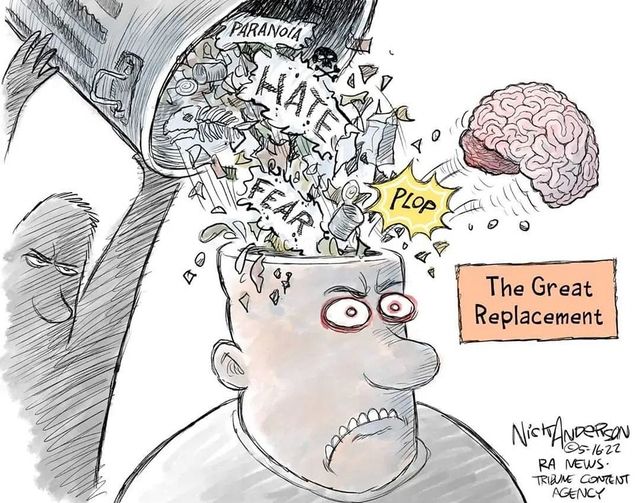
Outlandish conspiracy theories seem to be going mainstream; think the “great replacement,” which Tucker Carlson has been touting to his large audience, just to pick one example from many.
At Psychology Today Blogs, Sara Gorman and Jack M. Gorman take a look at what might make persons receptive to conspiracy theories. It’s a particularly worthwhile read at this juncture. A snippet (emphasis added):
Follow the link for the authors’ theories about what makes some persons predisposed to drink this poisonous pilsner.

Still Rising Again after All These Years 0
Clyde W. Ford points out that there’s nothing new about “replacement theory.”
The flaw is that equality is not “replacement” in any way. Nobody is being “replaced.”
Still Rising Again after All These Years 0
At the Houston Chronicle, Jeffrey Littlejohn opens a photo album and sees the history that Governors Abbot and DiSantis and their dupes, symps, and fellow travelers don’t want taught in schools.
Immunity Impunity
0
Not long ago, the bus carrying the women’s lacrosse team from Delaware State University, an HBCU, was pulled over for a minor traffic offense by the Liberty County, Georgia, sheriff’s department, then the team’s luggage and belongings were searched with drug-sniffing dogs.
The sheriff’s office maintains that racial profiling was in no way a factor. (Also, pigs. Wings.)
New Jersey Advance Media’s Ande Richards spoke to one of the members of the Lacrosse team about her experience.
(snip)
Kelly Harris, the director of Africana Studies at Seton Hall University, said this case exemplifies an instance where the police could be telling the truth and are wrong at the same time.
“They could have pulled the bus over for a routine incident. However, because racism is so entrenched in our society, treating Black suspects differently has been normalized — to the point that many police do not recognize their shortcomings,” he said.
Still Rising Again after All These Years 0
I remember the days of water fountains labelled “white” and “colored,” bathrooms ditto, even separate schools.
And there those who would bring those days back.
“An Armed Society Is a Polite Society” 0
Still rising again after all these years, oh so politely.

The Fascists’ Formula 0

Afterthought:
No, that’s not an understatement.
Fascism is knocking on America’s door, and far too many among us are willing to open that door.
Still Rising Again after All These Years 0
Rebecca Watson explores how arithmetic fell afoul of Florida’s ban on critical race theory historical facts. It’s an even uglier and more twisted story than you might expect.
Transcript here.
Afterthought:
When the Republican Party implemented its “southern strategy” in Richard Nixon’s second presidential campaign, it expected to use racism and bigotry as a tool to gain and retain power.
Now, five decades later, the Republican Party has become the tool and racism and bigotry its wielders.
Louder than Words 0
The Arizona Republic’s E. J. Montini points out that actions speak.
“White Fright” 0
Rebecca Watson looks at the long and inseemly history of the theory now referred to as the “Great Replacement” in American history, immigration policy, and culture and how these beliefs feed into right-wing violence, such as the recent mass shooting in Buffalo.
Transcript here.
The Pack of Lone Wolves 0
Thom eviscerates the myth of the “lone wolf” mass shooter.
The Fetishists 0
In the Pittsburgh Post-Gazette, Tony Norman tries to understand (some) Americans’ fascination with projectile-propelling portable phalli.
No excerpt or summary can do this article justice. Just go read the whole thing.
Buffaloed on the Disinformation Superhighway 0
The SPLC dissects the misdirection play. Here’s how the article begins; follow the link for the evidence.
In the wake of the Buffalo, New York, mass shooting, veteran disinformation posters on Twitter such as male supremacist Mike Cernovich and Malaysia-based RT (formerly Russia Today) contributor Ian Miles Cheong led a campaign to suggest that the terrorist harbored a left-wing ideology . . . .
Hate and Mongers of Hate 0
Seth skewers points out the internal contradictions in the right-wing’s racist “great replacement theory” myth lie.
We are a society of stupid.

Still Rising Again after All These Years 0
Field predicts that those who profit from America’s original sin will continue to foment death. An excerpt from his poat (emphasis added):
We are a failing state.
And we will continue to be a failing state as long as there are those among us who look away, look away, look away to Dixie Land.