







Geek Stuff category archive
Facebook Frolics 0
The EFF weighs in on Facebook’s flagrant failure to forestall repulsive rhetoric. Here’s a bit:
Follow the link for the full post and a link to their full submission to Meta’s Overlook Oversight Board.
And remember, “social” media isn’t.

“Influencer” Idiocy 0
At Psychology Today, Tamara Sobel looks at mounting evidence that “social” media isn’t. Here’s a tiny excerpt; follow the link for the article:

Doomed To Scroll 0
At Psychology Today Blogs, Phil Reed looks at the depressing effects of drowning oneself in an unending torrent of news, both from traditional and “social” media. A snippet (emphasis added):
Follow the link for the full article, including some suggestions for escaping the maelstrom of maliciousness and maintain a sense of perspective.
Artificial? Yes. Intelligent? Not So Much 0
The editorial board of the St. Louis Post-Dispatch asks an AI bot to incriminate itself, and it willingly complies.
Selling Snake Oil on the Disinformation Superhighway 0
Rebecca Watson parses the piffle.
or you can read the transcript.
And, while touring the Disinformation Superhighway . . . .

Battle of the Tech Bros 0
Psychologist Mike Travers suggests that the pending (potential? possible? preposterous?) cage match between Elon Musk and Mark Zuckerberg “is a snapshot of our culture.”
Afterthought:
If he’s correct, we’re in far worst shape than I feared.
Artificial? Yes. Intelligent? Not So Much. 0
At Psychology Today Blogs, Peter Kvam posits that “(d)ogs excel at many tasks where AI fails . . . .”
Follow the link for his reasoning.
The Disinformation Superhighway 0
To the surprise of all concerned, someone on “social” media gets held accountable.
Who woulda thunk?
Geeking Out 0
One of my computers died of old age (stuff wears out), so I now have a new toy. It’s my third ThinkPenguin, and they fulfilled my order in a most timely fashion.
It is a very nice piece of hardware, thank you very much. As an aside, I am not a fan of touchpads, but it does have one of most functional touchpads I’ve yet encountered.
I ordered it specifying Ubuntu MATE as the installed distro (ThinkPenguin lets you pick your distro, within reason), but, as I’m not really a big fan of the MATE desktop environment (actually, that’s not quite correct–I really like Plasma, but I don’t like Kubuntu, primarily because I loathe their package manager, so I went with Ubuntu MATE because the guys at Going Linux recommend it and I’ve used it before and it works quite nicely), I’ve already installed the Plasma desktop and am in the process of tweaking it to my preferences.
Eventually, natch, I’ll put Fluxbox on it, because Fluxbox is the ultimate combination of light-weight, configurable, and eye-candiability.
Of course, after I’ve installed Fluxbos, I will still be able to use MATE or Plasma. With Linux, you can have multiple GUIs installed and switch among them as you wish, something you can’t do with Windows or iJunk.
The Crypto Con 2
It seems the crypto “industry” has found a way to diversify. Here’s a bit from the story at Chron.com:
“August was a landmark month for Riot in showcasing the benefits of our unique power strategy,” Jason Les, CEO of Riot, said in a Wednesday release. Les said the company raked in $31.7 million in energy credits from the Energy Reliability Council of Texas (ERCOT), the agency that runs the Texas power grid, by cutting its power use by more than 95 percent during periods of peak demand.
The Crypto Con 0
Bruce Schneier expresses a tad of skepticism.
It’s All about the Algorithm 0
At Psychology Today Blogs, Mitch Abblett explores the seductive power of the algorithm, as it trains us to keep looking at “social” media feeds for the next little thrill. He calls it “nexting.”
Here’s a tiny bit, in which he explains how dopamine turns us into dopes:
Follow the link for some suggestions as to how to reclaim your life from the algorithm.
Artificial? Yes. Intelligent? Not So Much. 0
Real life is not a good place for laboratory experiments.
“And you might say well, 55, that’s not a lot. Well, if it’s your family, it’s a lot,” Nicholson said. “And for me, it’s not just your family, it’s everybody’s family. I’m responsible for everybody in this city. And so if we don’t get to one person, that’s one person too many that we didn’t get to.”
Afterthought:
Methinks one of the synonyms for “hubris” is “Tech Bro.”

Recommended Listening 0
Bad Voltage episode 3×60. It starts with an interesting discussion of “artificial intelligence” and “Large Language Models.”
If you are looking for good tech podcast, Bad Voltage is worth a listen. The podcasters know what they are talking about and they have a sense of humor.
In other geek news, my Zareason Media Box died after many years of faithful service. As Zareason is no longer with us (they were a victim of supply chain issues in the early years of the pandemic), I’ll likely replace it with a ThinkPenguin machine, as my ThinkPenguin laptop works very nicely thank you very much.
I must say, though, I miss Zareason. I’ve had several Zareasons (I’m typing on one now); they did quality work.
It’s All about the Algorithm 0
At Psychology Today Blogs, Nigel Barber takes a look at mounting evidence that “social” media isn’t. A snippet (emphasis in the original):
The Hateful Algorithm: Do Lots of Evil and Get Richly Rewarded
Contrary to the “do no evil” motto, social media companies can, at times, amplify political divisions and hatred. Their algorithms promote content that grabs attention, and the most effective way of doing this is often by boosting hateful speech that garners outrage and engagement. So, social media platforms are not just giving a megaphone to paranoid conspiracies but generally profiting from such dangerous rants because greater engagement translates into more advertising dollars.
I commend his piece to your attention.
Meta: Down at the Farm 0
This site was broken for a few minutes.
Thanks to the WordPress help pages, I was able to diagnose the problem and put a bandaid on it by disabling one of the plugins from the backend by renaming it in the phpMyAdmin file manager.
Whew!
Geeking Out 0
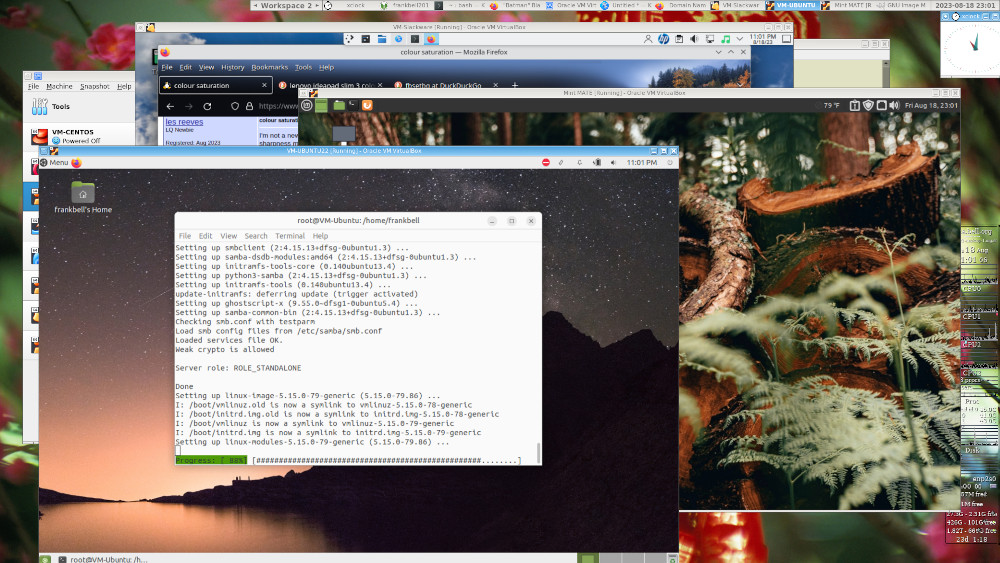
VirtualBox VMs of Slackware –Current, Ubuntu MATE, and Mint MATE on Mageia v. 8 under the Fluxbos window manager.