








2019 archive
“The Red Letter Year” 0
When I was in elementary school in Jim Crow Virginia, the third grade Virginia history book lauded the year 1619 as the “Red Letter Year” for three events:
- The first meeting of the Virginia House of Burgesses, the first representative assembly in the colonies.
- The arrival of the first English women in the colony.
- The arrival of the first black (the word in the textbook was, I believe, “African”) slaves.
At the Hartford Courant, Frank Harris III looks back on the legacy of that last event, America’s original sin, the effects of which soil this polity still.
Afterthought:
I wonder whether the schools still teach 1619 as a “Red Letter Year”? Hell, as I look about, I wonder whether they still teach history at all. (One of my friends recently told me of a conversation with a politically active young whippersnapper who did not know that President Andrew Johnson had been impeached, nor that Richard Nixon had resigned because he feared imminent impeachment and conviction.)

Dis Coarse Discourse 0
Wade Gilley has had enough.
I can’t say that I agree with him wholeheartedly, but I share his thoughts about the paid-by-the-puff opinionaters on my telly vision.
Doggone, Froggone 0
Despite what you read on the internet, it is not true that, if you raise the heat slowly, a frog will allow you to boil it to death. When it gets uncomfortable, the frog will flee.
Nevertheless, Shaun Mullen could not resist toadying up to that moldy metaphor.

Base Desires 0
If the image doesn’t display, click “alt text” to go to the original. Frankly, I’m baffled; I can’t find any errors in the HTML. Normally, I’d sweep this under the rug make the post “private,” but the image is too powerful to abandon. (Later) Darn thing seems to be working now. Electrons. Can’t live with ’em, can’t live without ’em. Furrfu.

Suffer the Children 0
Thom reports on a study that racist and sexist bullying among middle school children has increased since the election of Donald Trump.
Unknown Number, Unknown Name 0
At Psychology Today Blogs (you may have guessed by now that I like the site; I’m also a long-time subscriber to Psychology Today, as I found it immensely useful back when I was doing management training and organization development), GLenn Geher muses on the danger of a culture of anonymity, or, as he calls it, “deindividuation,” that is, the separation of an individual from his or her actions and the consequences thereof.
A snippet:
- You are on the phone with someone who refuses to reveal her name to you.
- You are playing a video game with someone virtually and that person’s screen name is HackerJacker2003.
- You get an email from someone and you have no idea who the author is.
- You get a Facebook message from someone whose Facebook name is clearly fake.
- You get a comment on your blog post by Anonymous.
… and so forth. Deindividuated communication is nothing short of rampant in this day and age.
That wouldn’t be so bad if there were no problems with the nature of deindividuated communication. But, as it turns out, there are lots of problems with deindividuated communication (see Zimbardo, 2007). When people’s identities are hidden, they are more likely to engage in anti-social behavior. They are more likely to bully. They are more likely to steal. They are more likely to kill. And so forth.
“An Armed Society Is a Polite Society” 0
The hunt for politeness continues.
The “hunter” has been detained.

Tales of the Trumpling: Snapshots of Trickle-Down Trumpery 0
Afterthought:
I wonder what they feel like, these racists and bigots, when they get a comeuppance.
(I made several attempts to finish that thought, but none satisfied me. I’ll just leave it to you to fill in the blank.)
Muddled Masses 0
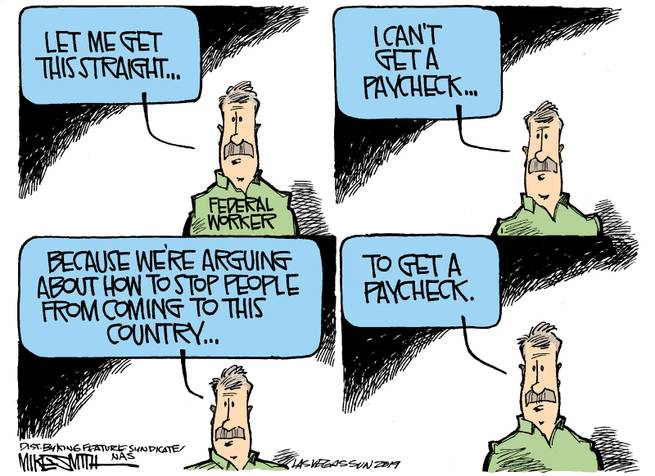
Over at Juanita Jean’s, El Jefe has some thoughts. Here’s a bit: