






From Pine View Farm

2020 archive

It’s All about the Algorithm 0

Arash Javanbakht, writing at Psychology Today Blogs, explores how “social” media’s algorithms, designed to keep us eternally engaged in ephemera, lead us down the disinformation superhighway. A nugget:

The artificial intelligence behind these platforms determines what you see based on your social media and web activity, including your engagement with pages and ads. For example, on Twitter you may follow the politicians you like. Twitter algorithms quickly respond and show you more posts and people related to that political leaning. The more you like, follow and share, the faster you find yourself moving in that political direction. There is, however, this nuance: Those algorithms tracking you are often triggered by your negative emotions, typically impulsivity or anger.

As a result, the algorithms amplify the negative and then spread it by sharing it among groups.

Share

The Oath Keeper 0

Ted McLaughlin takes inventory.

Share

Facebook Frolics 0

Facebook surfaces the scratches.

Share

“Cult 45” 0

At Psychology Today Blogs, Hogan M Sherrow considers whether the devoted followers of Donald Trump can be considered a cult.

Follow the link for his conclusion.

Share

Complicity 0

Republican Elephant with Donald Trump in an infant carrier on his chest.  Trump is setting the U. S. Constitution afire as the Elephant asks,

Click for the original image.

Share

The Disinformation Superhighway 0

Transitional disinformation.

Share

QOTD 0

Kerry Greenwood:

The cat didn’t care what he was called as long as he was always called for dinner.

Greenwood, Kerry, Dead Man’s Chest (Scottsdale, AZ: Poisoned Pen Press, 2010), p. 100.

Share

The Fade 0

Share

“Unshaken Faith” 0

The Pittsburgh Post-Gazette’s Tony Norman sticks his tongue in his cheek to pen a paean to Q and to those who crave his (her? its?) guidance.

Just read it.

Share

River Dance 0

No selfie awareness. No selfie awareness whatsoever.

Share

Facebook Frolics (Updated) 0

The reason for etiquette is that, without it, you might reveal who you really are, particularly if you forget, as so many do, that the internet is a public place.

Also, meet the Dean of the frolickers.

Addendum:

The Dean’s List has been revised.
Share

Bait and Switch 0

Share

Courting Disasters, Part the Nth 0

Evidence? Qu’est-ce que c’est cet “evidence”?

Share

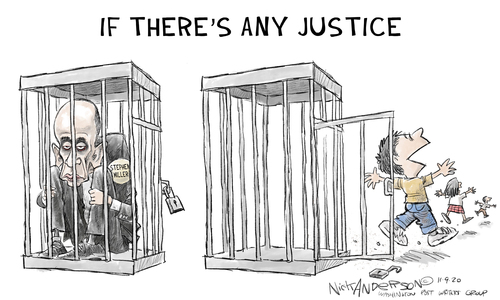
Republican Family Values 0

Title:  If There's Any Justice.  Image:  Stephen Miller locked in a cage as imprisoned immigrant child dashes out of one through the open door.

Via Juanita Jean.

Share

QOTD 0

Barry Commoner:

No action is without its side effects.

Share

A Tune for the Times 0

Share

Unexpected Lessons 0

At the Idaho State-Journal, Leonard Hitchcock muses on all the knowledge he has acquired because Hillary Clinton did not win the presidential election in 2016. A sampling:

Among the other things that Trump has encouraged me to learn about is psychology. We all enjoy being amateur psychologists now and then, but I never thought that I would find myself studying the DSM-5 to learn what the symptoms of narcissism are, or how to detect other pathological personality symptoms that Trump exhibits, such as persistent and compulsive lying.

Nor would I, for any other president, have been moved to read a book about his childhood in order to try to make sense of what has caused him to lack what I had assumed to be inherent human qualities, such as empathy.

Follow the link for more lessons learned.

Share

“But It’s the Only Possible Explanation” 0

In the current issue of Psychology Today, Jennifer Latson explores why persons are susceptible to illogical and often contradictory conspiracy theories. A snippet:

In a study published in 2012, (the University of Kent’s Karen–ed.) Douglas found that people who believed one conspiracy theory were more likely to believe another, even if it was logically impossible for both to be true. For example, the more someone believed the theory that Princess Diana faked her own death, the more they believed she’d been murdered by British secret agents.

How is this possible? Douglas concluded that people who are prone to conspiracy thinking are so quick to see a cover-up that they’re willing to let the logical niceties slide.

it’s a short read–four pages in the print edition. I commend the entire piece to your attention; given the state of dis coarse discourse, it is a particularly timely read.

Afterthought:

Yes, I still subscribe to publications printed on (gasp) paper.
Share

“An Armed Society Is a Polite Society” 0

I wonder, was it the antlers or the little fluffy tail?

Share

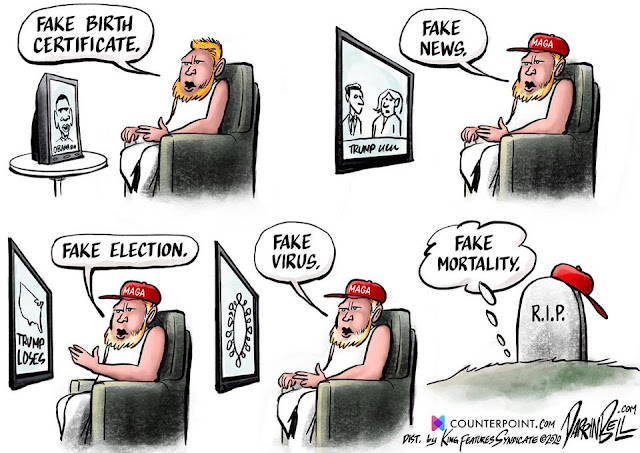
The True Believer 0

Frame One:  Man looking at Obama on television says,

Via Job’s Anger.

Share
From Pine View Farm
Privacy Policy

This website does not track you.

It contains no private information. It does not drop persistent cookies, does not collect data other than incoming ip addresses and page views (the internet is a public place), and certainly does not collect and sell your information to others.

Some sites that I link to may try to track you, but that's between you and them, not you and me.

I do collect statistics, but I use a simple stand-alone Wordpress plugin, not third-party services such as Google Analitics over which I have no control.

Finally, this is website is a hobby. It's a hobby in which I am deeply invested, about which I care deeply, and which has enabled me to learn a lot about computers and computing, but it is still ultimately an avocation, not a vocation; it is certainly not a money-making enterprise (unless you click the "Donate" button--go ahead, you can be the first!).

I appreciate your visiting this site, and I desire not to violate your trust.