







Hate Sells category archive

“The Armed Encampment on a Hill” 0
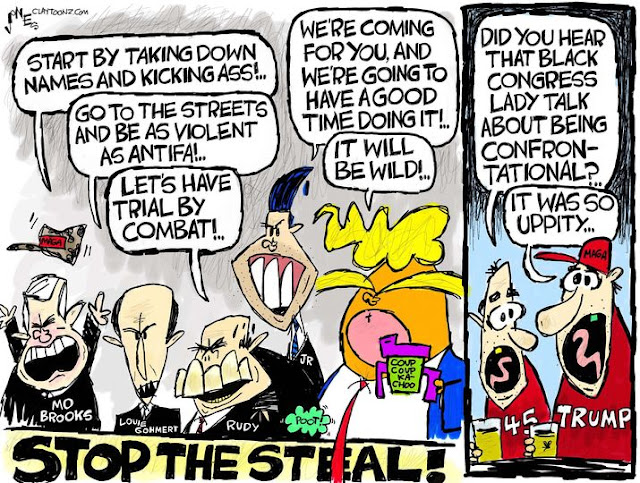
Thom marvels at what Republicans have done to America.

Cyber-Bigots Cultivate Virtual Bigotry 0
The Seattle Times takes a deep dive into the proliferation racist zoombombings and finds that they are increasingly coordinated efforts:
Follow the link for their evidence.
Stray Thought 0
Some would have you believe that intolerance of intolerance is intolerance.
Merchant of Hate 0
In a powerful essay at The Roanoke Times, Paul Angermeier reflects on the legacy of Rush Limbaugh.
I commend his piece to your attention.
Scars 0
At the San Francisco Chronicle, Cynthia Lin Sugiyama writes powerfully of her experiences with anti-Asian racism and bigotry as she grew up in the United States. Here’s how she starts her tale:
I remember the day I was targeted just because I was Asian.
I was 7, maybe 8? It was sunny. I was outdoors, happy and carefree. A group of much bigger, older Caucasian boys started walking toward me. That alone scared me. When they then proceeded to poke fun at me, saying, “Ching ching, chong chong,” laughing hysterically as they walked off, that then scarred me.
Follow the link for the rest.
All the News that Fits 0
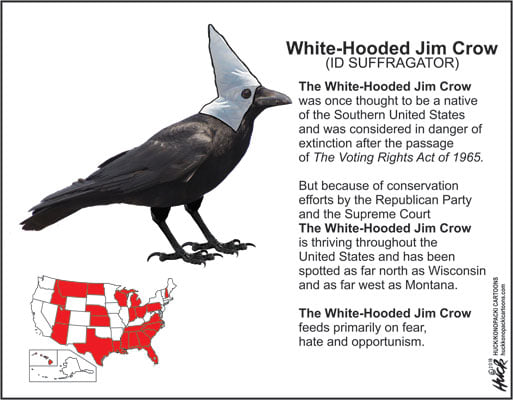
Farron finds a commonality.
Confluence 0
At Psychology Today Blogs, Glenn Gerber takes a look at the recent shootings in Georgia and argues that attempts to find a single reason for them are wrong-headed and futile. He suggests that several factors contributed to them:
- America’s Gun Problem
- Systemic Racism
- Systemic Sexism (and possibly–ed.)
- Mental Health Issues
Follow the link for his detailed exploration of each one.
A Notion of Immigrants 0
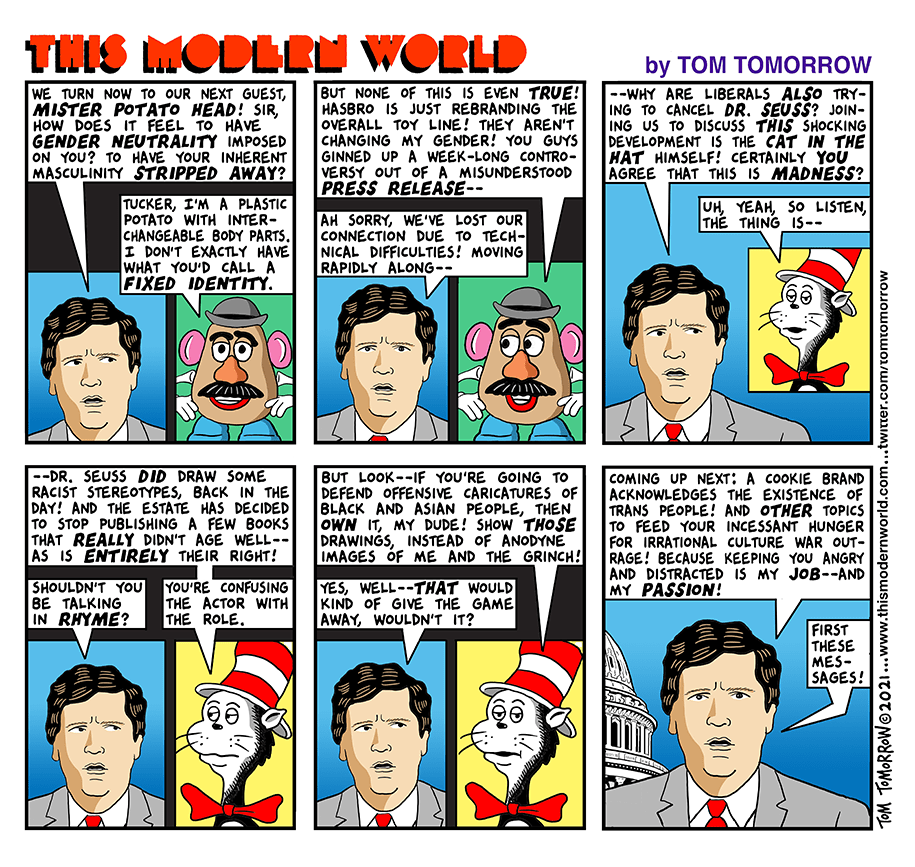
(Warning: Short commercial at the end.)

Craven Images 0
Trevor Hughes reports on the use of Christian symbols by right-wing extremists, whose credo is antithetical to a Gospel of love in any form (as their actions repeatedly prove), but which is entirely consistent with Leonard Hitchcock’s analysis of what he refers to as “Christian Nationalism.”
Here’s a bit from Hitchcock’s article; follow the link for the rest.
A broader underlying motivation is a deep resentment of cultural change and the ongoing collapse of a hierarchical social order in which their ranking might not have been very high, but it was secure, and lots of people were below them. For CNs, Trump’s slogan, “Make America Great Again,” signaled an intention to return to a past with which they were comfortable, a past in which the class and racial barriers between people were still intact, where Black people and immigrants, gays, atheists and women “knew their place,” and where white Protestants knew that they were the “real Americans” and were in charge.