






Health and Sanity category archive
Immune to Information 0
At Psychology Today Blogs, Joe Pierre examines the “infodemic” of conspiracy theories about COVID-19 and how they interact with anti-vaxx propaganda. Here’s a snippet:
In order to understand why this informational battle is being lost, at least online, it must be first understood that the anti-vaccination movement is not just a rag-tag group of people worried about vaccines, but a highly organized and strategically coordinated political campaign. And while its members are indeed comprised of parents from both sides of the political divide who are worried for their children, there are larger, dare we say conspiratorial forces operating behind the scenes of the movement.
Follow the link for the full article, including links to and citations of his sources.

The New Pastime 0
AL.com’s Kyle Whitmire notes that American roulette is now all the rage is his home state* of Alabama.
______________
*And, I would add, many others.
Wait Two Weeks 0
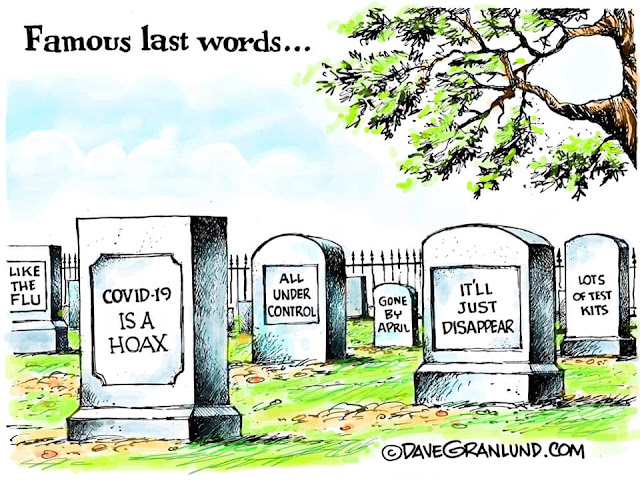
My two or three regular visitors know that I tend to ignore the daily hot-button kerfuffles that every leftie blogger thinks he or she must needs comment on and that I am not much given to prognostication (hell, I trained as an historian and understanding the past is hard enough–I’m not going to try to predict the future and you don’t want to know what that prediction would be anyway because it ain’t pretty), but, mark my words, just wait two weeks.
“Nobody Could Have Predicted . . . .” 0
Yet many persons did.
In my local rag, Steven T. Corneliussen rounds up a list of warnings of the possibility of and need to be prepared for a global pandemic reaching back almost three decades.
Numbers Gaming 0
Sam and his guest do the math and discover (surprise!) that the Trump administration is fudging the statistics on the effects of COVID-19.


Rx 0
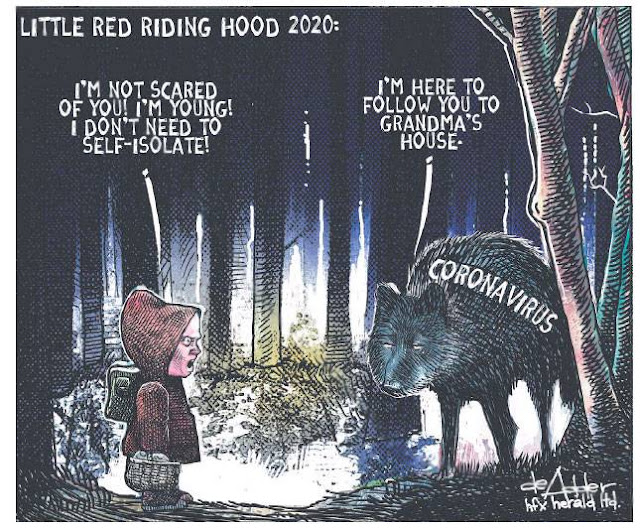
In the Portland Press-Herald, a Maine doctor who is actively involved in treating victims of COVID-19 offers some words of advice for these viral times (emphasis added):
I warn everyone away from those who call themselves “Doctor,” but either misappropriate the term (i.e., did not go to an accredited medical school) or no longer practice evidence-based medicine, using their titles to promote metaphysical ideas. Maine has a hardy crop. In the midst of a crisis, it is comforting to be around those who claim to know. Charlatans thrive in chaos. Accept a little discomfort, some unknowing, and double check all the “facts” that such people espouse ad nauseam. As Winston Churchill said, “When the eagles are silent, the parrots begin to jabber.”
Follow the link for the entire article. It is worth your while.
Against Covidiocy 0
At NJ.com, a nurse argues that the severity of COVID-19 has not been clearly communicated and pleads with persons to follow the rules during this pandemic. A nugget; follow the link for more, but be forewarned–it’s not pretty or comforting (emphasis added).
“Zoonodic” 0
Thom and his guest, Zach Corrigan, discuss how diseases can make the leap from animals to people.
You Can’t Trust Dr. Google 0
Not that that should surprise anyone.
Health Care in a Health Scare 0
Thom discusses how the “for profit” health care model is breaking down at a time when health care is sorely needed.


Truth in Labeling 0
At the Tampa Bay Times, Stephen Buckley, citing John M. Barry’s research, looks back at how news of the 1918 flue epidemic was covered and reminds us that reporting facts is not being alarmist. Here’s a bit:
In North Carolina, some newspapers would not publish the names of the dead.
One newspaper in Phoenix declined to write about influenza deaths there, or anywhere else. The paper, Barry writes, “was utterly silent, saying nothing about influenza anyplace in the country until the news was such that it could no longer keep silent.”