








Health and Sanity category archive

We Need Single Payer 0
At the Guardian, an English reporter forced to visit the ER tells of his experience with U. S. health care. A nugget:
No amount of fresh towels and edible breakfasts can make up for the feeling that your health is less important than the capacity of your chequebook.

We Need Single Payer 0
Sam Seder interviews Wendell Potter on tactics used by health insurance companies to keep customers in the dark about coverage and costs.
What they are most desirous of insuring is the executives’ country club memberships.
We Need Single Payer 0
In the Tampa Bay Times (the renamed St. Petersburg Times), Robyn Blumner describes her treatment for cancer. After praising the doctors, she moves to the subject of billing (emphasis added).
First, trying to be an educated consumer of health services by understanding pricing schedules is like cracking Enigma code. Second, the way the medical establishment and private insurance system is organized ensures that Americans get impersonal, redundant medical care for the highest cost, a subject I will discuss in my next column.
Any one who has had the simplest test done at a hospital become bewildered by the flurry of bills: two or three from different departments of the hospital, one from each doctor, one from the janitor, several from persons you never heard of. It is easy to imagine that the process is impenetrable on purpose.
Republicans like to talk about shopping for health care as if it were like shopping for a television.
Try it.
The sleazy used car dealers down the side streets are paragons of openness and disclosure when compared with the business end of the health care industry.
We Need Single Payer 0
Life insurance has been described as a wager: You bet that you are going to die, the life insurance company bets you won’t, and you hope that they win the bet.
Of course, you know the death rate is the same everywhere, as Mark Twain observed: One per person.
Nevertheless, the gag points out what gets forgotten: insurance companies don’t want to pay claims; they want to pay the bosses’ country club memberships. Their business model is founded on not paying.
The Philadelphia Inquirer details the attempt of a severely crippled 27 year old woman–one whose hands and legs are too weak for her to maneuver herself–to get a modern wheelchair.
People who evaluate and fit patients for wheelchairs say cases like hers have become more common in recent months. They say many requests for the kind of chairs that patients like Lorey use – expensive, motorized units with multiple custom features – are being denied because insurers and Medicare officials are worried about high costs and fraud. Doctors, physical therapists, and patients must appeal the decision, or else the patients give up and accept lesser chairs.
“It’s gotten to the point where words are not enough to convince the medical directors” of insurers, said assistive technology professional Robert Townsend of Jeff Quip, a Boothwyn company that supplies complex chairs.
Experts said patients who fight – especially those who appeal in person – often can get the chair they need, but during the bureaucratic battle, they must make do with loaner chairs or lie in bed.

We Need Single Payer 0
So we don’t need special events like these:
So many people stood in line seeking dental care Friday than many were told to come back Saturday. Many of those who couldn’t see a dentist before the event ended were given information about dental clinics around the area.
Woodstock police estimated 2,300 to 3,000 people were waiting outside the church when the doors opened Friday morning at 5 a.m. Some had waited since Thursday morning.
The Galt and the Lamers, Competition Dept. 2
Price competition in health care: The fee hand of the market at work.
Such “trade secret” clauses are standard in the medical world and exempt from public records laws, they say. But the secrecy means that Jackson can’t compare its prices to what many other hospitals pay. That’s like a consumer going to buy a flat-screen TV and not knowing what others are paying for the same brand, said Curtis Rooney, president of the Health Industry Group Purchasing Association. “We call them gag clauses. … People can’t find out the best price.”
Free market.
Competition.
It is to laugh.
We Need Single Payer 0
Field reports from the field:
Follow the link for the citation.
We Need Single Payer 0
Not payola payers.
We Need Single Payer 0
We are headed to a society with three classes: the insurance executive bonus babies, the insured, and the dying.
Even the low-income children who were not rejected had to wait an average of 42 days for appointments for urgent conditions such as diabetes, seizures, asthma, or a bone fracture – 22 days longer on average than children with private insurance.

We Need Single Payer 0
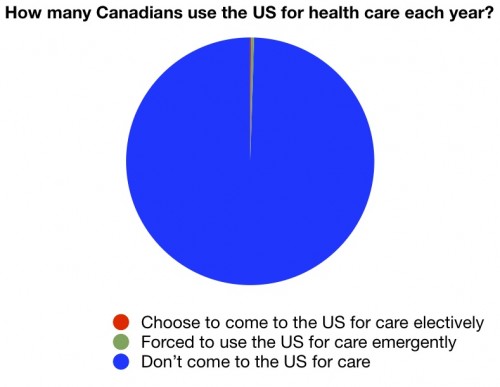
Jay Bookman of the Atlanta-Journal Constitution debunks the lie that competition will magically reduce the cost of health care to consumers.
Here’s one of his charts. Follow this link to read the article.

We Need Single Payer 0
At Bloomberg, Paul Ryan has an article claiming that competition will lower health care costs, a favorite claim of righties.
Missing is reality. Obtaining medical care is not like buying an MP3 player.
- In much of the country, there is no competition. In my part of the world, one hospital company controls almost all the hospitals. If the EMTs have to transport me, they get to choose among Sentara, Sentara, Sentara, and Sentara.
- If someone has, say a heart attack, he or she doesn’t get estimates for the cost of treatment. He or she likely isn’t even conscious so as to be able to shop around.
- If a woman is having a baby (something that gives more notice), she doesn’t shop around for a delivery room; she goes to the hospital her doctor uses.
- If I need an EKG, I’m not going to shop for a new lab; I’m going to where my doctor sends me.
Republican paeans to market competition are no more than empty propaganda to perpetuate oligarchy, promote monopoly, and placate the most significant Republican constituency: Wall Street bonus babies.
Or maybe they’re just all smoking dope.
We Need Single Payer 0
Also, the Atlanta Journal-Constitution has a long story about hospital markups, that is, what persons with no insurance have to pay. A nugget:
That’s largely because people don’t shop for medical care and hospitals don’t provide cost estimates, Anderson said.
“There is nobody saying to [the hospitals] on behalf of the uninsured and a few other groups that they can’t do it,” Anderson said.
“You just had a heart attack or your appendix burst, so you can’t negotiate a price and you wouldn’t know how much it cost even if you could,” he said.
Via Balloon Juice.
Solution Looking for a Problem 0
This is not news.
This is why cooking was invented.
Also, 136 samples?
The new estimate is based on just 136 samples of beef, chicken, pork and turkey purchased from grocery stores in Chicago; Los Angeles; Washington, D.C.; Flagstaff, Ariz.; and Fort Lauderdale, Fla.
(snip)
The new study found more than half the samples contained Staphylococcus aureus, a bacteria that can make people sick. Worse, half of those contaminated samples had a form of staph that’s resistant to at least three kinds of antibiotics.
I am more concerned about the “resistant to at least three kinds of antibiotics” part.
We Need Single Payer . . . 0
. . . because a health insurance industrial complex whose primary purpose is paying the country club memberships of its executive bonus babies by denying health care is likely to have a whatchamaycalllit oh! right conflict of interest:
MedSolutions was hired in July 2009 to review claims before doctors administered tests such as knee MRIs and CT scans of the brain. The firm stood to lose money if it did not reach its 20 percent savings target, according to the report. Such a contingency violated state law. It was removed from the contract last summer.
We Need Single Payer 0
Matt Ruben, writing at Philly dot com, considers the Republican war on the sick and infirm.
It’s all about the country club memberships. Here’s a bit:
So the private insurers, and the financial firms heavily invested in them, stand to make lots of money from 40 million new customers, as all of the nation’s seniors would remain in the private market at age 65 instead of being able to get Medicare. And you, your children and your grandchildren would subsidize those profits by paying more and more to the insurers during all those years after age 65.
To add insult to injury, the GOP plan also calls for more tax breaks for the wealthiest Americans. So the vast majority of us, who really need Medicare, wouldn’t even get a tax break to help offset the increased costs.
It’s a scam, pure and simple, another front in a class war being waged by the relative few who get rich off their investments, on the majority of Americans who survive primarily by working for a living.