








Political Theatre category archive
Republican Family Values, “Honor Thy Father and Thy Mother” Dept. 0

Aside:
A small quibble: Trump did not make the remark about grandparents sacrificing themselves, but he might as well have.

Lies and Lying Liars 0
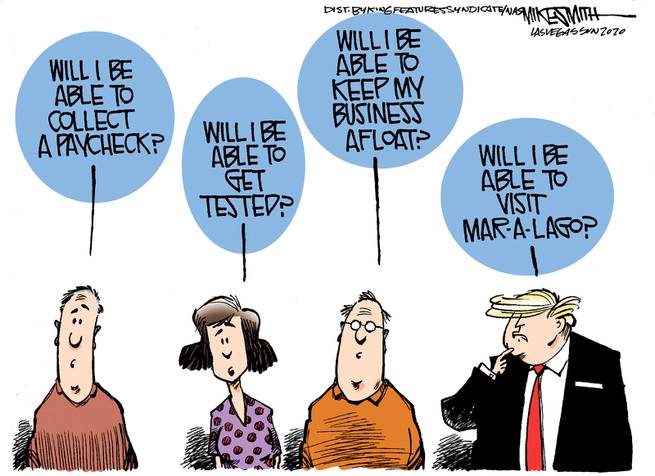
Farron catalogs Donald Trump’s lies about coronavirus.
Denial Is Not Just a River in Egypt 0
Two recent posts at Psychology Today Blogs offer insight into the intersection between political leanings and failure to take seriously–even to actively discount–the seriousness of the rapid spread of COVID-19.
Nassir Ghaemi offers a taxonomy of disease deniers:
Meanwhile, Nigel Barber identifies an irony:
Given the confused and chaotic–often self-contradictory–response to the coronavirus by the current Federal Administration and tendency of many to, say, confuse a Facebook frolic with a fact, I commend both pieces as being worth the few moments it will take to read them.
Aside:
My grad school professor for early federal period history, Dr. Shade, was fond of saying that “history is irony.”
Far too often, history has proven him correct, as when the United States went from having its first black President to having the most racist President since Woodrow Wilson.


Both Sides Don’t 0
Leonard Pitts, Jr., fears that the United States will not find unity to combat the threat of the coronavirus. Here’s a snippet (emphasis added):
And I’m sorry, but you’ll read no false equivalence here — not even in the service of hoped-for reconciliation. Because the truth matters. And the truth is, it was the political right that seceded from that greater and larger “us,” that inculcated in its adherents a sense of separateness, that made of them an island warmed by a burn of permanent grievance.
Follow the link for the rest.
What’s in a Name? 0
Sometimes, quite a lot.

Lowering the Barr 0
Methinks that a strong argument can be made that the current United States Attorney-General is the nation’s top law defacement official.
Rand Gestures 0
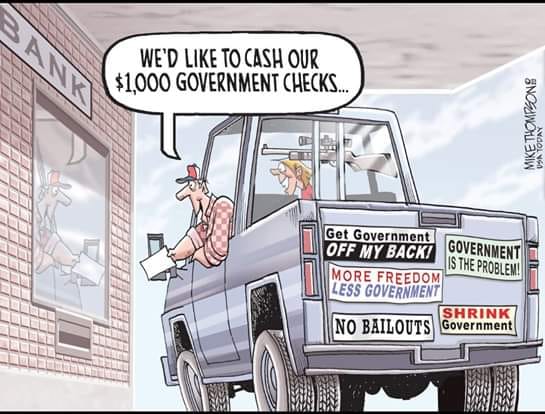
And yes, Joe Patrice, to use your words, some Senators are indeed gobsmackingly stupid.
A Tune for the Times 0
Warning: Some language.
Crisis Response 0
At The American Scholar, Philip Alcabes argues that the coronavirus presents us with a crisis, but not as it is being portrayed. He suggests that actual crisis is manifest in three ways. Here’s one; follow the link for the other two.
Second, we face a crisis of leadership. The playbook for a public health approach to contagion is clear and well known, and it has been practiced often: test widely for infection, trace contacts of the infected to locate further cases, isolate cases so they don’t infect others, refer the sick for treatment. But that has not happened yet in the United States. It should have, but it didn’t.
(snip)
Why this kind of stewardship didn’t happen is hard to know. Perhaps there’s no hope for such stewardship in an administration that has not so much created a vacuum of leadership as actively attacked it. For instance, Anthony Fauci, director of the National Institute of Allergy and Infectious Diseases, has often tried to take on the role of communicator, only to be undermined by the president. We are left with the present siege situation.
Epidemiology, Opening the Door Dept. 0
At the Portland Press-Herald, Herb Janick, makes the case that the Republican Party paved the way for the coronavirus through its failure to consider and protect the common good. He gives three examples of how it did so; follow the link for his discussion of each one:
First, rather than recognize that the federal government has a critical role, the Republican Party has spent years denigrating and demonizing the government and its important role in society.
Second, the Republican Party has sought to diminish the role of experts and science and replace them with ideology.
Third, the Republican Party has supported a president who manifestly is not fit to lead.
Senatorial Privilege 0
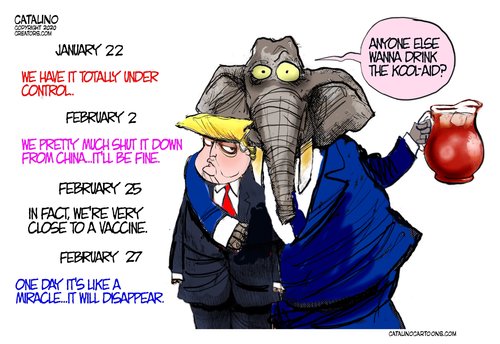
At Above the Law, Joe Patrice comments on what he calls the “COVID Four,” the four (so far) Senators who have been revealed to have sold shares of stocks coincident with receiving secret briefings about the coronavirus. A nugget (emphasis added):