








Political Theatre category archive
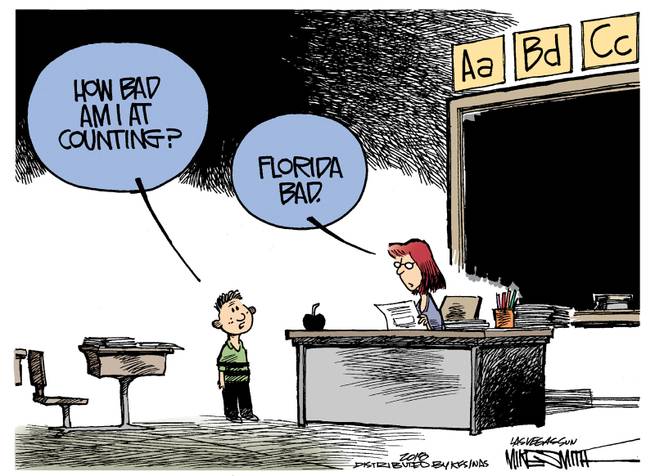
Upcoming Strategies To Gut Out the Vote 0
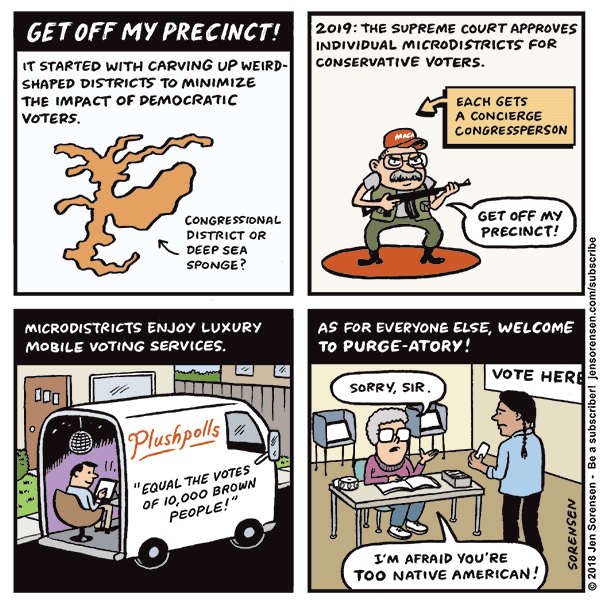
Juanita Jean adds context (follow the link for more):

The Bend of History 0
Werner Herzog’s Bear looks back at World War I and then at the fool who declared that the fall of the Berlin Wall somehow signified “the end of history,” and observes that
Follow the link for the full post.
Russian Impulses 0
Shaun Mullen admits that he is an optimist.
Disinformation Society 0
David argues that high voter turnout is good, even if many of the voters are uninformed. He makes some interesting points.
Hactivist 0
Jay Bookman suggests that, as regards his selecting Mark Whitaker as “acting Attorney-General,” Donald Trump knew exactly what he was doing. A nugget:
Follow the link for the rest.
Unquestionable 0
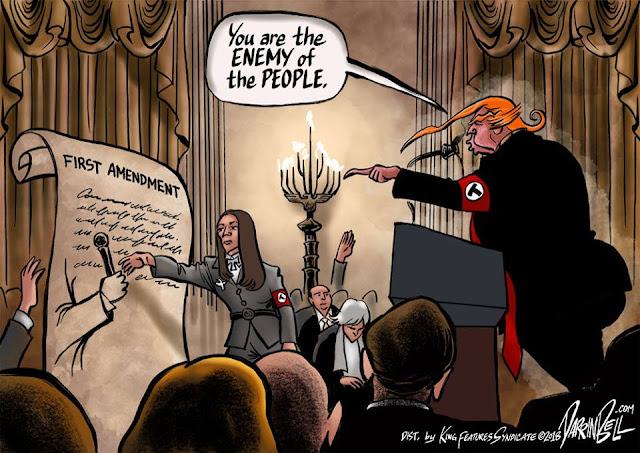
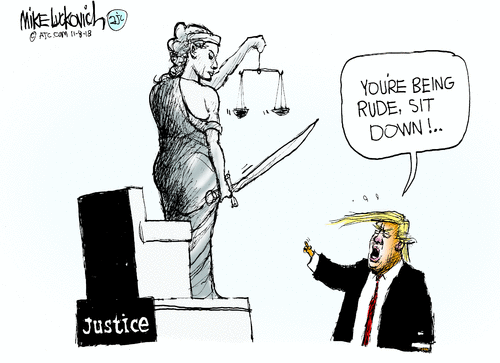
Leonard Pitts, Jr., notes Donald Trump’s fear of being asked questions. A snippet (emphasis added):
(snip)
But Trump is different. And perhaps that’s no surprise, given that he’s a con artist who has spent decades shucking, jiving, deflecting and blustering his way past every moment of accountability. The man with no answers naturally fears the man asking questions.
The Fact Factor 0
David and his caller discuss the end of facts as a factor in elections.

Presidential Participation Trophy 0
Will Bunch suggests that President George the Worst does not deserve to receive an award that has variously been shared by Nelson Mandela, Malala Yousafzai, and Rep. John Lewis.
Methinks he has a point.
(Broken link fixed.)
A Line on Lines 0
Thom and his guest suggest that, if persons are willing to stand in line for iJunk, they should be capable of standing in line for a ballot.
Aside:
This was posted the day before the election, but it’s relevant any time.
“The Other” 0
In a piece that I suspect fear will be quite useful in examining the results of this election, regardless of the outcome, Cannon Thomas explores the dynamics of “us” vs. “them.” Here’s a bit:
Here’s what mobilization against “them” looks like:
- We identify people or groups of people who are a threat to what we value and begin to have intense automatic emotional reactions to them. These emotions are well-studied and arise before we have even mentally processed the content of what the other person is saying.
- That gut emotional response shapes and informs all of our opinions and attitudes. The reaction precedes any rational awareness of the content of the issue, and our attitudes are very hard to change from that point. We create very elaborate and convincing arguments for what we already felt. People are wired to assume what they see is all there is, so we fail to realize that we are becoming entrenched in a very limited perspective.
- We minimize or marginalize the other person or group. We process them as less human, more limited or impaired on a moral level, and as less “right” than we are. How else could they fail to see what is so obvious to us?
- We mobilize against them to protect what is “right” or “good.” Sometimes we do it with the sense of being engaged in a moral good; sometimes we do it with a frustrated defensiveness. Regardless, we fight for what we believe is right.
The result, in any situation where cooperation is required, is disastrous.
Remember, for Republicans, everybody else is a “them.”
“A Pointless Waste of Time” 0
David points out that fact-checking Trump is a pointless waste of time, because his dupes, symps, and fellow-travelers don’t care and everyone else is already on to him.
