








Political Theatre category archive
No Laughing Matter 0
At Psychology Today Blogs, Scott Weems argues that Donald Trump can’t tell a joke. (Of course, he can’t take a joke, either, but that is an entirely other matter.)

The Greatest Snow Job on Earth! 0
At The Hartford Courant, Jennifer Tucker assesses the similarities and differences between P. T. Barnum and Donald Trump. Here’s two differences (emphasis added):
Even more notably, Barnum cited truth-telling as a necessary condition for success in business: “Let your pledged word be sacred,” he wrote, since “Nothing is more valuable to a man in business than the name of always doing as he agrees.”
Follow the link for the similarities.

The Court Is in Sessions, “Useless Eaters” Dept. 0
This is a pile of vile.
Political Fallout 0
I have a brown leather vest that I truly like to wear in lieu of a jacket on mild days.
Now, thanks to “Judge” Roy Moore, I am ashamed to be seen in it.
The Singularity 0
Robert Reich argues that Donald Trump is like no other president. A snippet:
I beg to differ.
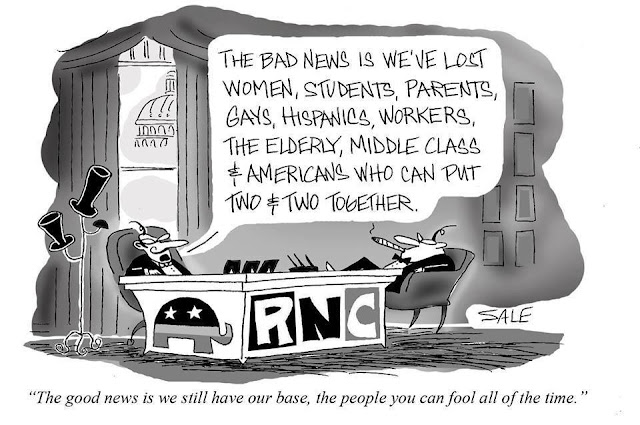
America has had its share of crooks (Warren G. Harding, Richard Nixon), bigots (Andrew Jackson, James Buchanan) and incompetents (Andrew Johnson, George W. Bush). But never before Donald Trump have we had a president who combined all of these nefarious qualities.

“The Conscience of a Conservative” 0
At AL.com, Clete Wetli argues that that phrase is an oxymoron. Here’s a bit; follow the link for the whole piece.
It is no accident that it has become the safe harbor for white supremacists and religious zealots.

A Picture Is Worth 0
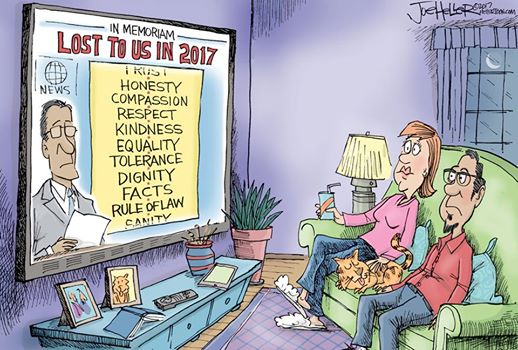
Here’s an excerpt from a short article by Josh Marshall that seems related . . .
. . . while Solomon Jones list the year’s biggest moments in racism.
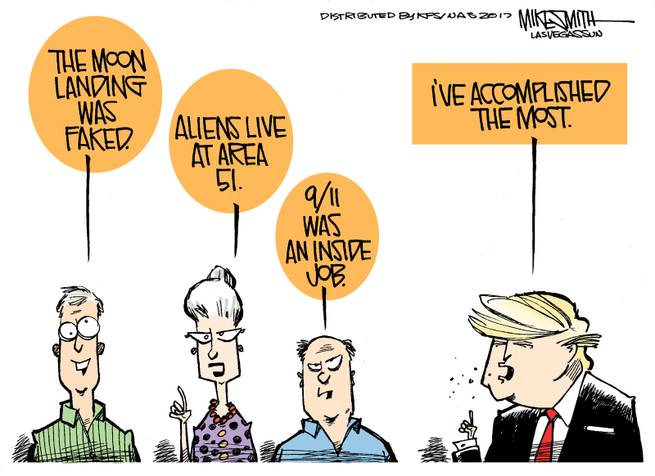
Image via Job’s Anger.

Social Engineering 0
At The Nation, Edward Burmila looks at the social assumptions underlaying the Republican tax deform bill. A snippet:
I think not having the estate tax recognizes the people that are investing, as opposed to those that are just spending every darn penny they have, whether it’s on booze or women or movies.
Upon first reading, I knew I had seen this comment somewhere before. It turns out Grassley was channeling the British economist Thomas Malthus in his seminal Essay on the Principle of Population (1798):
The labouring poor, to use a vulgar expression, seem always to live from hand to mouth. Their present wants employ their whole attention, and they seldom think of the future. Even when they have an opportunity of saving they seldom exercise it, but all that is beyond their present necessities goes, generally speaking, to the ale house.
Malthus spoke to a common mindset among the upper classes that the poor were beyond help. Poverty, it was widely believed, was a sign of a weakness, . . .
Via Gin and Tacos.