








Political Theatre category archive
Mythbuster 0
The Rude One marvels at Trump’s fact-free interview with Time Magazine. Here’s a snippet (emphasis added, warning: language):
When someone believes their own mythology, they become parodies of themselves. Trump has never not been that parody, and now, as his supposedly legendary dealmaking ability falls to pieces in the health care bill debacle, he is frantically trying to maintain the illusion of the myth. Without that myth, he’s just a sad old man in an ill-fitting suit who wants to play truck driver.

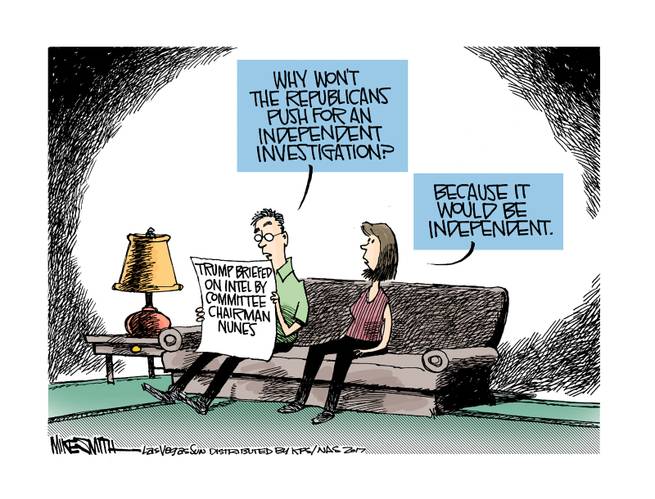
Stop the Pressers! 0
In The Roanoke Times, history professor Robert A. Strong recounts examples of lies from various Presidential administrations from Eisenhower (denying spy flights over Russia) through Kennedy (denying having Addison’s disease) through Carter (denying planning military action to rescue the hostages in Iran) through Reagan through Clinton and so on. He points out that the lies have generally ranged from national security issues to campaign promises to personal issues, but that they stopped short of denying objective reality that was in public view.
He maintains that Trump’s lies are different in both degree and kind (emphasis added).
In a piece that eerily covers the same ground, Der Spiegel suggests that Trump is more interested in freedom of propaganda than in freedom of the press.
McCurry believes that Trump would like to curtail press freedom. “If he could issue an order that the only coverage allowed of him was positive, he would do so without delay.”
Projecting the Loss 0
At Psychology Today Blogs, Stanton Peel returns with another post about Donald Trump; Peele argues that Trump’s reaction to Republicans’ pulling their “they laughingly call it a health care” bill is a classic illustration of psychological projection.
Here’s a bit:
Um, Mr. President? No votes were taken with Democrats present.
Psychological projection is a syndrome in which humans defend themselves against their own unconscious impulses or qualities by denying their existence in themselves while attributing them to others.
Donald Trump’s speech on the defeat of the health care bill he supported was a model of projection.
Do please read the rest.
Ryan’s Derp (Updated, Kicked to the Top) 0
It’s not the war.
Afterthought:
Thanks, Obama.
Addendum:
SeattlePI previews the next strategy to make America sick again.
Votes Matter 0
Pandora points out the Trump voters shouldn’t be surprised now that they are getting what they voted for.
Buck Hunting 0
Noz goes looking for where the buck stops.
Mean for the Sake of Mean 0
Robert Reich discusses Donald Trump’s proposed budget. Some excerpts:
(snip)
. . . unnecessarily cruel.
(snip)
. . . unnecessarily cruel.
(snip)
. . . unnecessarily cruel.
Follow the link to see why he says that.

Homer Had the Catalog of Ships.
Trump Has the Catalog of Lies.
0
TPM catalogs the biggest lies in Trump’s Time Magazine interview.

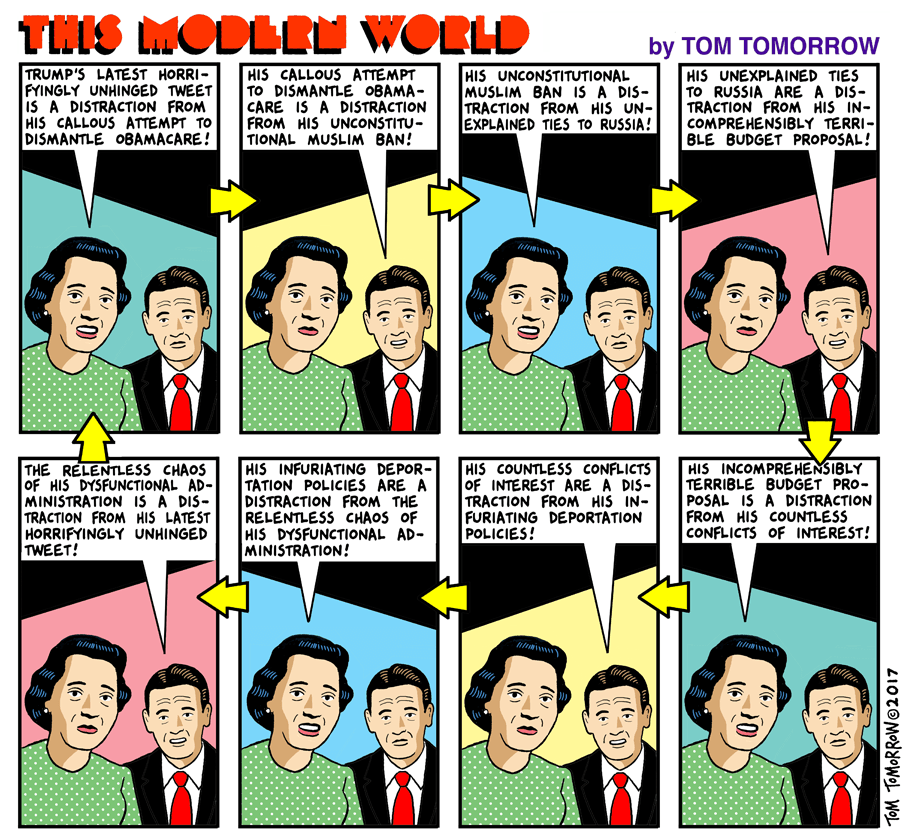
Image via C&L, which explores the ways in which conservatives strive to avoid and deny the truth about the Trumpling of America. (Excerpt below the fold.)

In the Court of the Crimson Orange King
0
I’ve wondered for a while whether Trump thought he was elected king, not president. Werner Herzog’s Bear seems to share that wonder. An excerpt from his post:
Twits Who Can’t Stop 0
At Psychology Today Blogs, Stanton Peel posits the existence of “addictive experiences.” I personally have qualms about using the term “addiction” for anything other physical addiction, as to tobacco, narcotics, and the like–substances for which cessation of use produces physical withdrawal symptoms. Much of my skepticism is based on claims of “sexual addiction,” which too often seem to be rationalizations for bad behavior.
Without putting my skepticism aside, I offer here his list of criteria for “addictive experiences.”
1. The activity/experience alleviates negative emotions for the individual, particularly those supporting his identity and self-image.
2. The addictive activity operates in a rapid, predictable way so that the gratification is instant.
3. The consequences of the action are negative, thus exacerbating the person’s negative feelings.
4. The person responds again in the only “safe” (meaning reliable) way he knows how to perform.
5. The addicted individual thus fails to develop alternative, more effective coping mechanisms to produce the emotional reassurance he seeks and requires.
At this final point, when the individual is wholly dependent on a behavior or involvement for his emotional stability, he can be called addicted.
I’ll give you one guess as to whose what type of behavior inspired the post. Follow the link to see whether you got it right.
Turkish Taffy Pull 0
The Local delves into the history of the current strained relations between Germany and Turkey. It seems a bit superficial and anecdotal, but, if you you want to understand some of the headlines coming out of Europe these days, it may be a good place to start.
All That Was Old Is New Again 0
As the Booman said, “History doesn’t repeat itself, but it rhymes.”
At the Minneapolis Star-Tribune, a veteran of the Nixon administration sees some similarities between Donald Trump and Richard Nixon; here’s a snippet:
Afterthought:
Remember that the Watergate scandal sprung from Nixon’s paranoia, his fear that he would lose an election that he already had in the bag. Were it not for that paranoia and the misdeeds it engendered, Richard Nixon would be remembered much more favorably than he is.