








Political Theatre category archive
“The Creeper” 0
Shorter Will Bunch: There are no baby steps in the march to tyranny.


On the Spread of Stupid 1
Alex Caron of the Portland Press-Herald notes the proliferation of stupid. A snippet:
From both American and world history, we know where the dictatorship of the stupid takes a society: to autocracy, mediocrity and strife. And to the enrichment of a few over the many and a general collapse of civil society.
Let’s be careful not to confuse stupidity with ignorance or lack of education, although they generally expand together. . . .
Stupid is different. To win a degree in stupid, you have to willfully reject facts in favor of superstitions, myths, fears and conspiracy theories. And then get all your news from fake or biased news sites targeted at the stupid.
Post Mortem 0
Shaun Mullen looks back on 2016,
Ideal vs. Real 2
Thoreau submits the thesis that, when you forget high-sounding theory, Today’s North Carolina is American democracy in practice, with ample precedent: petty, mean-spirited, vengeful, and power hungry.
Follow the link for his reasoning.

Twits on Twitter 0
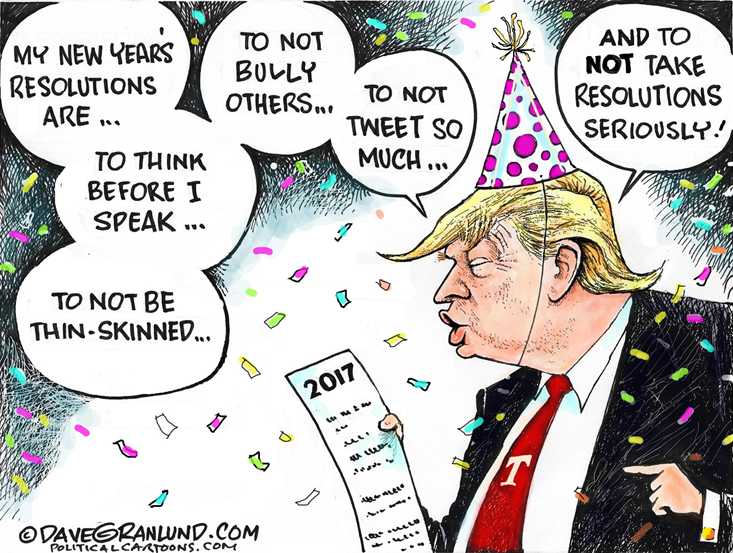
Trudy Rubin, who is currently touring the Far East, notes that twitting twits cannot be equated with diplomatic diplomats. A snippet:
Nor do tweets convey toughness to the Chinese.
Indeed, Trump’s modus operandi is more likely to provoke Chinese retaliation than produce a great deal.
Do read the rest.
Afterthought:
The inherent weakness of relying on the Bully’s Pulpit as one’s go-to strategy is that, when you meet someone who won’t be bullied, just what the heck do you do next?
White Christmas 1
In a typically long and densely reasoned post, Chauncey Devega explores the Christmas imagery of the movie, A Christmas Story. That’s the story woven from several of Jean Shepherd‘s stories, which opened to disappointing reviews and receipts, but which has since become a Christmas staple of television.
Some of the lessons he draws might surprise you. Here’s a bit.
(snip)
Black people are present in “A Christmas Story.” There are several black children in Ralphie’s elementary school classroom and, like their white peers, they participate in pulling a prank on their teacher. There are also some black folks watching the Christmas parade. There is a black man in Black Bart’s gang, which attacks Ralphie’s home in a fantasy sequence and are beaten back by his deft use of that Red Ryder BB gun.
The black characters in “A Christmas Story” are present but remain peripheral. They have no real voice or agency. They are shown in an perfectly inoffensive and neutral fashion. They are “present” in much the same way as the minor white characters who are not members of Ralphie’s family or his circle of friends.
Follow the link for the rest.
Full Disclosure:
I am a big fan of Jean Shepherd’s writing. When I was a young ‘un, back in the olden days, I’d catch his radio show on the skip from WOR-AM in New York City whenever the atmospheric conditions were favorable. In his own way, he captured the essence of growing up as boy (and, as Devega points out, quite specifically a white boy) in America in the late 1940s and 1950s. As a white boy who grew up in America in the 1950s, I realized that when I discovered his stories (I was maybe twice Raphie’s age when I did) and can attest to it today.
Jean Shepherd did not pretend to write profound fiction or social realism; he was a humorist. Nevertheless, that does not in any way impeach attempts to draw social lessons from his work. Heck, popular culture often tells more about day-to-day social reality than the ponderous works of self-proclaimed serious artistes.
I don’t remember there being any persons of color in any of his short stories–and I read almost all of them–and I do not think that reflects on Shepherd in any way other than that he was a product of his times. Because of segregation de facto and de jure, employment and housing discrimination (repeat after me: “Redlining“), when Shepherd was growing up in America, a white person outside the South could be born and grow to maturity without ever seeing, not to mention interacting with, a black person or a brown person or an Asian person, except for possibly seeing one of them on the Ed Sullivan Show.*
To the extent minorities were present in the movie, they were a creation of times of the movie, as Devega points out, not of the times of the stories, and I commend Devega’s analysis of the phenomena to your attention.
________________
*This sentence was slightly edited for clarity at 11:20 a. m. EST.
The “Still Face” of Society Is Still There 0
Back in the olden days, when I was young ‘un studying history and sociology at my alma mater, the condition described in this article would have been called anomie.
Twits on Twitter (Updated) 0
Addendum, Later That Same Afternoon:
Dick Polman has more. A snippet: