







Political Theatre category archive
All the News that Fits 0
Will Bunch notes the corporate media’s selective perception. A snippet:
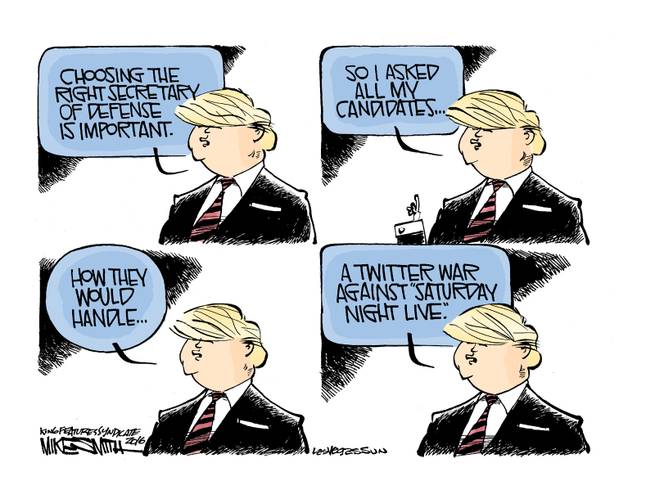
No one should have expected anything different from the media. Why educate readers about “the emolument clause” when the Hamilton story had it all — high theater, literally, and a simmering row between a rainbow coalition of coastal elites (and their beloved smash-hit play) versus a heartland vice president-elect … and his hot-headed boss. Suddenly, Trump’s remarkable fraud settlement and his business conflicts were a Page 17 story. Especially when he piled on by tweeting the next morning about how unfunny Saturday Night Live has become when several skits lampooned him or his supporters.

Detritus 0
Jim Wright looks at the first week of Trumpery and is less than impressed. A snippet:
Follow the link, read the rest, then weep for my country.
Next, don’t give up.
Facebook Frolics 0
Froma Harrop has had enough of the Zuckerborg. A snippet:
Stray Thought 0
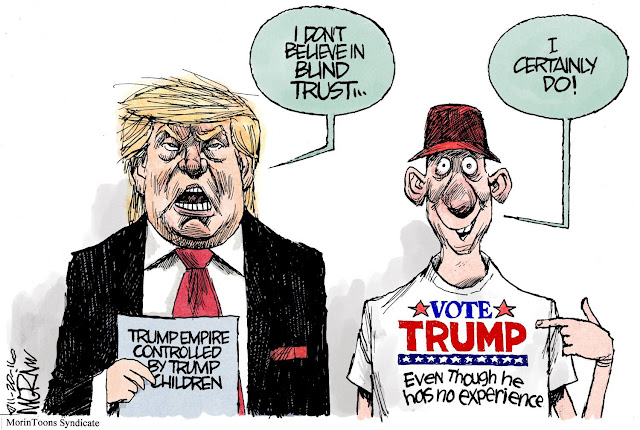
Donald Trump seems to be acting as if winning the Electoral College tally in the recent popular vote is akin to a successful hostile corporate takeover.

Twits on Twitter 0
Jack Ohman twits the twitter-in-chief.

Buyer’s Remorse 0
Shorter Erika D. Smith: You get no sympathy from me.

No More Classes, No More Books, No More Teachers . . . . 0
In a lengthy essay, Alan Taylor looks at the place of education in United States history. He points out that, by and large, the founders believed strongly that an educated citizenry was essential to the survival of the new nation and pushed, sometimes with more success, sometimes with less, to make learning more available. Ultimately, this resulted in a strong system of public education.
He fears this trend has reversed, as school budgets are cut back, college students are laden with debt, class-sizes increase, and public systems of higher educations are being starved for funds. Here’s bit from the essay; follow the link for the whole thing (emphasis added).
Although the current definition of education is relentlessly economic, the source of the crisis is political. Just as in Jefferson’s day, most legislators and governors believe that voters prefer tax cuts to investments in public education. Too few leaders make the case for higher education as a public good from which everyone benefits. But broader access to a quality education pays off in collective ways: economic growth, scientific innovation, informed voters and leaders, a richer and more diverse culture, and lower crime rates—each of which benefits us all. Few Americans know the political case for education advanced by the founders. Modern politicians often make a great show of their supposed devotion to those who founded the nation, but then push for the privatization of education as just another consumer product best measured in dollars and paid for by individuals. This reverses the priorities of the founders.
Trumpling the Privatization Scam 0
These people do not believe in the existence of a common good.