








Political Theatre category archive
Playing the Triangle 4
Werner Herzog’s Bear wonders whether the sun may be setting on “triangulation.”

History. It’s a Thing That Happens. 0
The Tampa Bay Times carries Nick Danforth’s article, in which he tries to add some real actual history to Western mythology about Sunnis and Shiites. Here’s a snippet:
Perhaps the biggest problem with this historical narrative is that it ignores everything that happened between 680 and, say, 1980.
The causes of “sectarian” violence are almost always located in the present, not the long-ago past. If you did deep enough, economics–haves vs. have-nots–is often a prime driver.
The Galt and the Lamers 0
Juanita Jean explains what happens when you vote Libertarian.
One more time: A Libertarian is a Republican who’s ashamed to admit it.

Your Tax Dollars at Work 0
Recycling:
In related news, it would seem that the Sea Dragon has problems much more serious than can be remedied by a few jalopy egg-beaters.
Meanwhile, Congress continues to push the F-35, which nobody wants except manufacturers of weaponry and their sycophants and lapdogs.
Too Many Governments 0
One of the things that most confused me when I moved to Pennsylvania was the structure of local government.
As a native Virginian, I understood Virginia, and, frankly, many aspects of Virginia’s structure make sense, even as the persons who fill elective offices often do not. “Independent cities,” for example, are a great idea. Cities are not part of counties. Therefore, if you are in a city, the only jurisdiction to hold accountable is the city; bucks cannot be passed back and forth between cities and counties. If the governance of the independent city is incompetent, there is only one government to blame. If voters do not turn them out, it’s their own damned fault.
Pennsylvania counties are divided into townships and boroughs for no good reason that I could ever figure out (“borough” is a term for a “township” that is a little more urban than the surrounding area, such as Narberth, the wonderful place where I lived; it’s a “township” on steroids that, anywhere else, would be called a “town”).
After a while, I figured out that most local governance was provided by the township; that’s where I registered to vote, for example. As far as I could figure out, counties existed mostly to create sinecures jobs.
I did a little research and learned that, after the American Revolution, there seemed to be two schools of thought regarding how to promote democracy. One school advocated concentrating power in the hands of elected representatives as a way of guaranteeing “democracy.” The other believed that the more elected officials, the more “democracy”; New England’s town meetings are perhaps the extreme example of this.
Pennsylvania seems to have opted for the latter choice. There are lots of little jurisdictions with lots of elected officials (one of the elected officials was a “prothonotary”–never did figure out what that was, a notary with a big nose, maybe, though Wikipedia tells me it is what anyone else would call “Clerk of the Court”). I remember reading somewhere that Pennsylvania has over 44,000 state and local elected officials, second highest in the nation, though it is a middling-sized state in both area and population.
Now, a couple of decades after I lived there, Pennsylvania’s system of local governance seems to be collapsing under its own weight.
One thing is certain: No solution that involves reducing the number of jurisdictions or elected officials will be brooked. The number of Babbitts must be held constant.

Dystopian Utopia 0
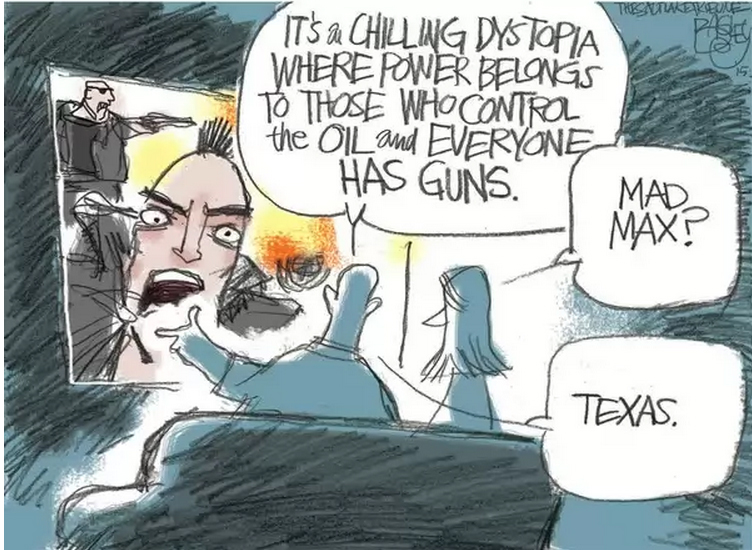
Elon elucidates the verbal gymnastics. Listen to the audio at the link, then subscribe to TWIB.
Via Juanita Jean.